


“We don’t stop playing because we grow old; we grow old because we stop playing.” — George Bernard Shaw
In most cities, the center is reserved for what we have agreed is serious. The seat of government. The financial district. The cathedral. Walk to the middle of a capital, and you can usually read, from the architecture alone, what that society believes is important enough to protect.
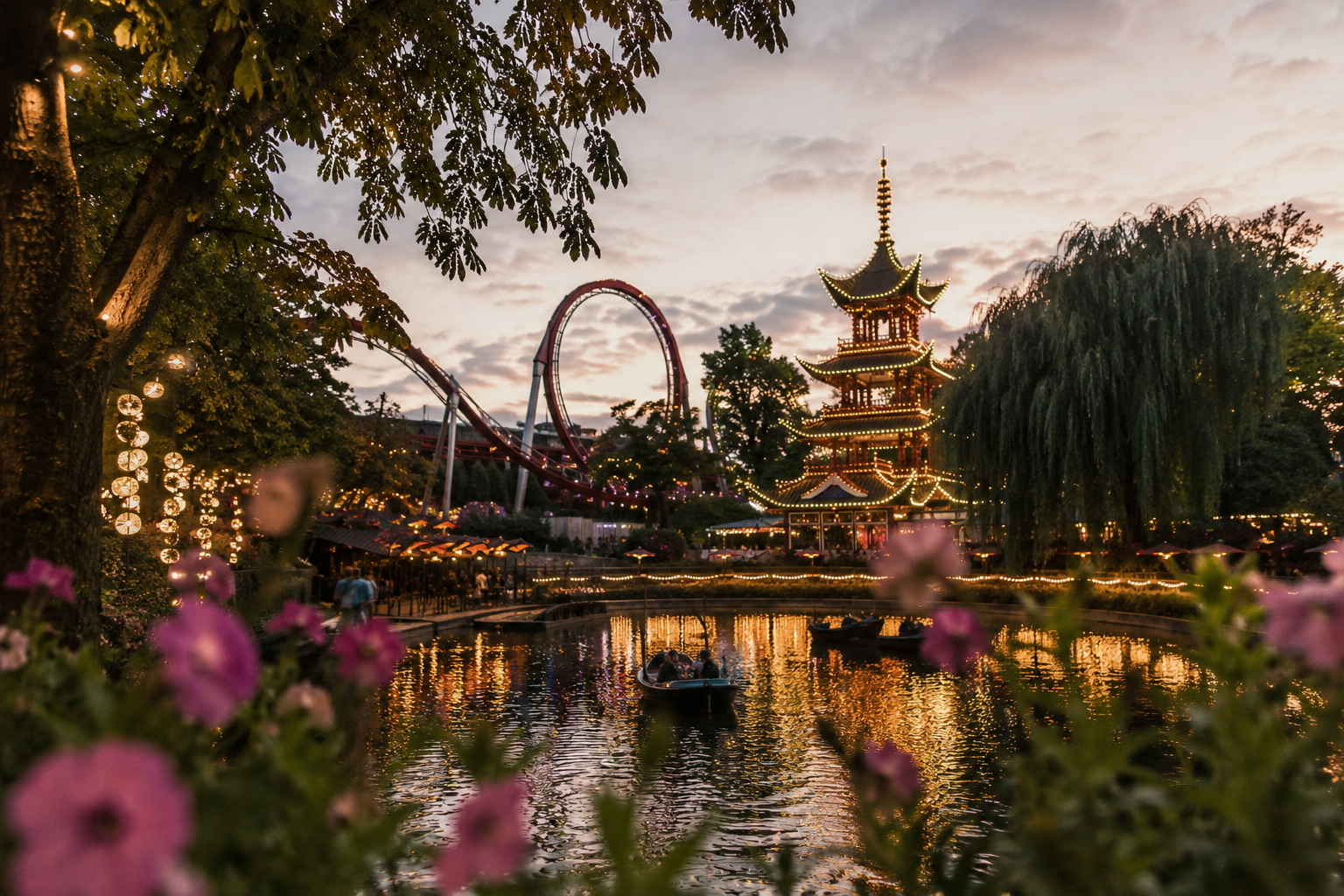
Walk to the middle of Copenhagen, and you arrive at an amusement park.
Tivoli Gardens has sat in the heart of the city, between City Hall and the central train station, since 1843. It is one of the oldest amusement parks in the world, and it is not tucked away on the outskirts where such things usually live. It occupies some of the most valuable land in Denmark, and it has never been asked to justify itself by moving to a cheaper location. I had been to Copenhagen several times and somehow never made this observation. This time, while I was in town for a speaking engagement and to participate in the Future Days conference, I finally did. And I have not stopped thinking about what it means that an entire culture decided to put play at its center and leave it there for nearly two centuries.
I went expecting to think about design. Copenhagen is a mecca for it, and I finally made it to the Designmuseum Danmark, which was amazing. I was invited to visit UN City, the striking complex on the harbor where the United Nations does some of its most important work. Both were exactly as substantial as I expected. But the thing that lodged itself in me was the realization, standing among the lights of Tivoli, that this city does not treat play as the opposite of seriousness. It treats play as part of the infrastructure of a good life.
Here is the detail that turned the visit into an argument I cannot put down: when Georg Carstensen sought the king’s permission to build Tivoli, he made his case with a line that has aged into something almost subversive: when the people are amusing themselves, they do not think about politics. He meant it, in 1843, as a pressure-release valve for a restless population. But strip away the period context, and what he understood was this: play is not a distraction from the serious business of life; it is a precondition for it. A city that gives its people somewhere to wonder, to ride, to be delighted, is building something more durable than another office tower would have given it. Carstensen himself said the following year that “Tivoli will never, so to speak, be finished,” a sentiment that still holds. The park draws over four million visitors a year. It was partly burned during the Nazi occupation. Copenhagen rebuilt it.
The Dutch historian Johan Huizinga put the deeper argument into words that I think every leader should sit with. The assumption that play is the opposite of seriousness, he wrote in Homo Ludens, is neither conclusive nor fixed. Genuine play is one of the main bases of civilization. Civilization does not merely allow play. It arises in it and never fully leaves it. Walt Disney understood this, too. He came to Tivoli in 1951 and reportedly took copious notes. What struck him was not a single ride but the atmosphere: spotless, beautifully lit, full of music, and priced so that nearly anyone could come. He took what he learned back to California and built Disneyland on its bones. The most influential temple to play in the modern world was, in part, reverse-engineered from a nineteenth-century Danish garden that a king allowed to be built mostly to keep people happy.
I keep returning to this because of a pattern I constantly see among the leaders and teams I work with. We treat play the way most cities treat their amusement parks: as something nice, something for later, something to be relegated to the edges once the real work is handled. We schedule it last and cancel it first. We carry, often without noticing, a quiet belief that seriousness and play are opposites, and that maturity means choosing the former. The offsite has a fun activity bolted onto the end, after the agenda that matters. The creative exercise is the thing we cut when we run short on time.
But Copenhagen suggests a different architecture. Tivoli is not bolted onto the end of the city. It is load-bearing. The play is not a reward for the seriousness; it is part of what makes the seriousness sustainable. The Danes did not build a great city and then, having earned it, allow themselves a park. They put the park at the center and built the great city around it.
What would it mean to design your own environment that way? Not to add more fun in the thin sense of forced levity and trust falls, but to treat play as structural. To put the thing that delights people near the center of how the team operates, rather than at the periphery, where it gets cut first. Play is where people take the risks that lead to invention, where they drop the armor that blocks real collaboration, where the brain does the loose, associative work that no amount of grim focus can force. The teams that protect a little room for delight are no less serious. They are the ones still capable of surprise.
I left Copenhagen with the usual designer’s appreciation for beautiful chairs. But the thing I carried home was smaller and harder to shake. Look at what a place protects at its center, and you learn what it truly values. Most of us, if we are honest, have built our working lives with play out at the edges, the first thing sacrificed when the pressure rises. Maybe the braver design is to move it back toward the middle. To decide that delight is not what we get to do once the serious work is done, but part of what makes the serious work possible at all. What sits at the center of the thing you are building? And what did you leave out at the edges that might belong closer to the heart?
If this sparked something for you, a new question, a new perspective, or a quiet knowing, you don’t have to explore it alone.
Join my newsletter
Or book time to connect.