


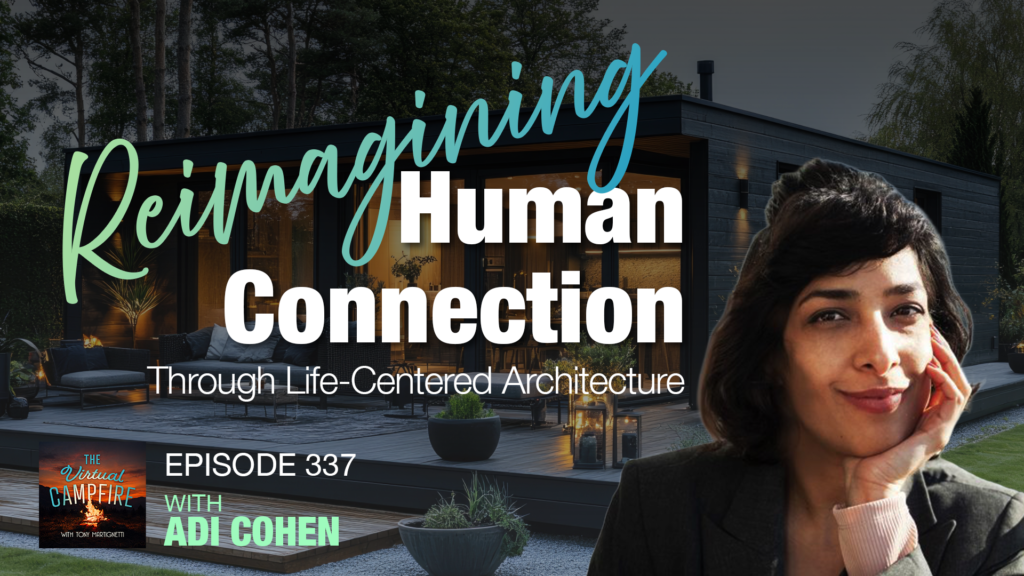
What happens when you achieve everything you thought you wanted, only to discover that the life you’ve built no longer feels like your own?
For architect, experience designer, and founder of The New Movement, Adi Cohen, that realization became the beginning of an extraordinary transformation.
In this episode of The Virtual Campfire, Tony Martignetti welcomes Adi for a thought-provoking conversation about the environments we inhabit, the identities we construct, and the courage required to step away from a familiar life in search of something more meaningful.
From leaving a successful architecture career and traveling the world with a single carry-on suitcase to spending 45 days completely offline in sacred landscapes, Adi shares how curiosity, uncertainty, and reconnection with nature transformed her understanding of what it means to truly live.
Her journey raises a powerful question:
Are we designing our lives around what makes us successful, or around what makes us feel alive?
Questioning the Life We’re Supposed to Want
Growing up in Israel, Adi remembers watching adults rush through their daily routines, commuting, working, and struggling to find time to enjoy the lives they were working so hard to support.
Even as a child, she questioned the logic of it all.
Why were people spending so much energy maintaining lives they barely had time to experience?
That curiosity would become a recurring theme throughout her life.
Inspired in part by her mother’s involvement in ecological farming, Adi became fascinated with the relationship between environments and human well-being. If plants could flourish when placed in conditions that supported their individual needs, why couldn’t we design human environments with the same intention?
She began imagining what she describes as a form of human ecology, where architecture could support connection, well-being, creativity, and a deeper sense of belonging. That fascination eventually led her to architecture. But the profession she entered wasn’t quite what she had imagined.
When the Dream Becomes the Trap
Adi spent years studying architecture, earning her qualifications, and building a successful career. She eventually became a partner in an architecture firm. By conventional standards, she had achieved exactly what she’d set out to accomplish. Yet something was missing.
Despite her passion for designing meaningful places, she found herself spending her days in the same office, under the same lighting, following the same routines. The career she had pursued to help people feel more alive was leaving her feeling increasingly disconnected from her own life. After six years, she reached a difficult conclusion. She didn’t necessarily know what she wanted next. But she knew what she could no longer continue doing.
So she made a radical decision.She left her career, sold or gave away her belongings, and purchased a one-way ticket to Japan. With a small carry-on suitcase and no clearly defined plan, Adi stepped into the unknown. What followed wasn’t the end of her architectural career. It was the beginning of an entirely new relationship with it.
Discovering a Different Way to Create
As Adi traveled, she began connecting with people from different cultures, industries, and communities. Unexpectedly, opportunities to design started finding her. People invited her to collaborate on projects, explore ideas, and bring her unique perspective to spaces around the world. The very profession she thought she might need to abandon returned in a different form. But this time, it fit the life she wanted to create.
Rather than working from one office, Adi was drawing inspiration from an expanding collection of places, experiences, and human connections. She began developing a new understanding of architecture: not simply as the design of physical structures, but as the creation of environments that shape how people feel, behave, and connect.
Her journey eventually led to The New Movement, a life-centered architecture and experience design studio exploring the relationship between place, perception, and human flourishing.
The experience taught her that sometimes we don’t need to abandon our ambitions. We need to reconsider the assumptions about how we’re supposed to pursue them.
Curiosity as a Way of Life
When Tony asks what qualities made Adi’s unconventional journey possible, her answer is refreshingly simple. Curiosity. Openness. And a willingness to say yes to experiences that might initially feel uncomfortable.
Adi is also the host of the podcast Go Out and Talk to Strangers, a title that reflects one of her most important philosophies. Go somewhere unfamiliar. Start a conversation. Be willing to discover something you didn’t know you were looking for.
For Adi, the possibility of repeating the same unfulfilling routine can be more frightening than trying something new. But she also recognizes that everyone is different. Some people thrive with consistency and routine. Others need variety, exploration, and change. Neither approach is inherently better. The important thing is understanding what genuinely supports your own sense of well-being.
What Happens When We Disconnect?
After years of traveling and running her business from different parts of the world, Adi began noticing another pattern. Although she had escaped the confines of a traditional office, she was still constantly connected. There was always another project, another email, another idea, another responsibility. So she decided to experiment.
She spent 45 days completely offline, traveling through China and Tibet, visiting sacred places, walking mindfully, and allowing herself to step away from the identities and obligations that normally occupied her attention. She wasn’t trying to develop a new business strategy. She wasn’t searching for her next professional breakthrough. She simply wanted to experience what it felt like to be. Without the constant noise, the familiar labels, or the pressure to turn every moment into something productive.
That experience profoundly influenced her understanding of presence, creativity, and human connection. It also inspired her to begin inviting others on pilgrimage journeys through sacred landscapes.
Rediscovering Our Connection With Nature
Today, Adi lives in Norway, where she appreciates a cultural relationship with nature that challenges many modern assumptions.
She describes the Scandinavian tradition of spending time in simple cabins, sometimes without electricity or running water, as a powerful reminder of what it means to disconnect from modern distractions.
One of her favourite observations is that, in Norwegian, people speak of going into nature rather than out to nature. The distinction invites us to reconsider our relationship with the natural world. Perhaps nature isn’t somewhere we escape to. Perhaps it’s somewhere we return to.
For Adi, this perspective also informs her architectural work. The spaces we occupy aren’t neutral containers. Their lighting, materials, temperature, layout, and relationship with nature influence how we feel and interact with others. And if our environments shape us, we should be more intentional about how we design them.
The Lost Art of Doing Nothing
Throughout their conversation, Tony and Adi explore something increasingly rare in modern life: the ability to sit comfortably with emptiness. Without reaching for a phone, looking for entertainment, or needing to accomplish something.
Adi recalls volunteering at a Zen temple, where she spent hours carefully removing unwanted plants from a patch of grass. The task required her complete attention. Whenever her thoughts wandered to lunch, tomorrow’s plans, or something else, she returned to the simple act of working with the grass.
What initially seemed repetitive became an unexpected experience of presence and joy. For Adi, the lesson extends far beyond meditation. In a world increasingly filled with digital tools, artificial intelligence, and endless possibilities for productivity, our ability to pause and reflect becomes even more valuable. The faster we can create, the more important it becomes to understand what is worth creating. And sometimes the most meaningful ideas emerge when we allow ourselves to stop filling every available moment.
Redefining Success on Your Own Terms
Toward the end of their conversation, Adi shares an exercise that helped her reconsider the direction of her life.
Imagine your ideal day. Or your ideal week. Not the version that reflects someone else’s expectations of success. Not the version that looks impressive from the outside. But the one that genuinely feels right for you.
Where would you spend your mornings? What kinds of experiences would energize you? How much time would you spend working, creating, exploring, or connecting with others? What would you choose if you gave yourself permission to question the familiar patterns?
For Adi, this exercise became an ongoing practice. Her answers have changed as her life has evolved. And that’s part of the point. We’re allowed to change. We’re allowed to outgrow the identities we’ve worked hard to establish. And we’re allowed to redefine success as we discover more about ourselves.
Key Takeaways From This Episode
- Why conventional definitions of success don’t always lead to fulfillment
- How architecture and our physical environments influence human well-being
- The importance of recognizing when a familiar identity no longer serves us
- Why curiosity and openness can create unexpected opportunities
- How Adi rebuilt her relationship with architecture while traveling the world
- What 45 days offline taught her about presence and creativity
- Why nature and meaningful environments are essential to human connection
- How boredom, stillness, and silence can create space for new ideas
- Why the rise of AI makes intentional creativity even more important
- How to begin designing your days around what genuinely matters to you
A Question to Take With You
If you could design your ideal day without worrying about what success is supposed to look like, what would you change?
Perhaps the first step toward a more meaningful life isn’t making a dramatic change.
Perhaps it’s simply giving yourself permission to imagine something different.
ABOUT ADI COHEN
Adi Cohen is a thematic architect, experience designer, and founder of The New Movement, a life-centered architecture and experience design studio exploring the relationship between place, perception, and human flourishing.
Her work brings together architecture, neuroaesthetics, deep sensing, and wisdom from living traditions to create spaces and experiences that support deeper human connection.
She also curates pilgrimage journeys to sacred landscapes in the Himalayas and beyond, and hosts the podcast Go Out and Talk to Strangers.

Adi Cohen’s Links
Adi’s Company Website
The New Movement
Adi’s LinkedIn
adi-cohen-architect
Adi’s Podcast
Go Out & Talk to Strangers
Adi’d Instagram
nomad.architect.me