

We often celebrate the individual who dares to do something extraordinary.
The visionary who challenges conventional thinking. The entrepreneur who turns an idea into a business. The creative mind who discovers a possibility nobody else could see.
But behind many remarkable achievements, there’s a story we don’t always tell.
The story of someone else.
Someone who asked a better question. Challenged an assumption. Offered a different perspective. Or simply believed in an idea before it became something real.
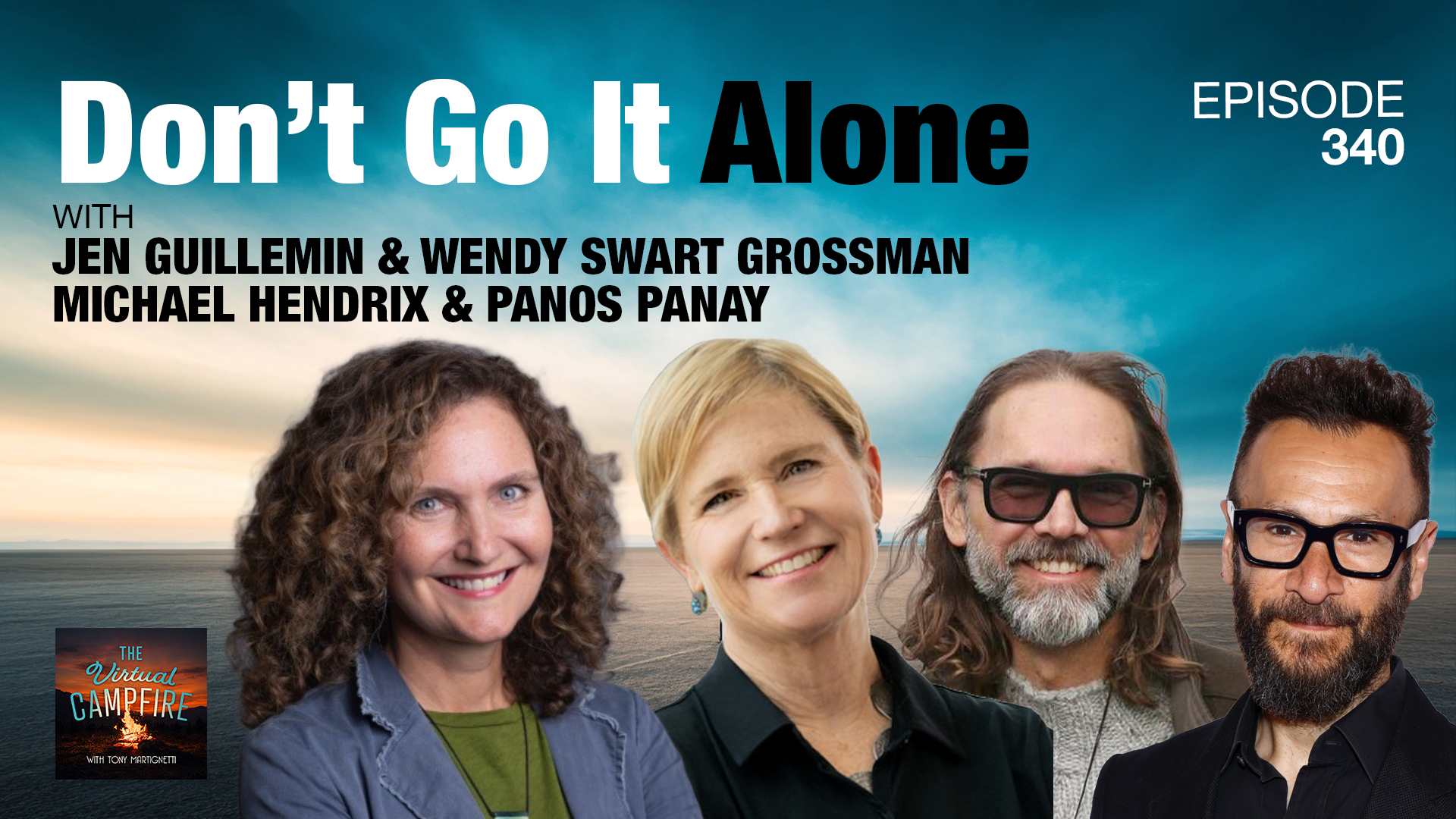
In this concluding chapter of the Campfire Lessons for Leaders special series, Tony Martignetti explores one of the most important lessons from his book: Don’t Go It Alone.
Through two remarkable conversations featuring four creative thinkers, Tony examines how friendship, trust, curiosity, and complementary talents can transform what’s possible.
Jen Guillemin and Wendy Swart Grossman share how their friendship grew into a creative partnership built around the power of the arts, education, and meaningful community engagement.
Michael Hendrix and Panos Panay explore how a chance meeting, mutual curiosity, and a willingness to embrace uncertainty became the foundation for an extraordinary creative collaboration.
Their experiences offer a compelling reminder:
The right people don’t simply help us accomplish more. They help us imagine more.
Different Beginnings, Shared Values
Every meaningful partnership begins somewhere.
For Wendy Swart Grossman, the search for connection began early in life.Growing up, Wendy moved frequently, living in different communities before she had even reached her teenage years.
Rather than developing a single, permanent sense of home, she became fascinated by what it meant to create community wherever she found herself. That curiosity would eventually influence her professional interests and her desire to bring people together.
Jen Guillemin’s childhood offered a striking contrast.
While Wendy experienced movement, Jen experienced deep roots. She grew up in a small town in upstate New York, surrounded by family, music, and a strong sense of place. Her mother was a voice teacher whose students regularly filled their home with music and conversation.
Jen watched people arrive feeling exhausted or burdened by the day, only to leave with renewed energy and joy. One of her most powerful memories came during the final weeks of her mother’s life. As her mother battled cancer, former students and community members delivered Christmas ornaments accompanied by personal stories.
Each ornament represented a relationship, a memory, or an expression of gratitude.
For Jen, it became a moving illustration of how creativity and the arts can shape lives far beyond the moment of performance. Later, she encountered another influential figure: her father-in-law, the Boston public artist known as Sidewalk Sam.
His large-scale chalk drawings and community art projects reinforced Jen’s belief that creative expression could bring people together and transform public spaces.
Although Jen and Wendy arrived at their professional lives through very different experiences, they shared a fundamental conviction.
Community matters. Creativity matters. And meaningful connection has the power to change how people experience the world.
When Friendship Becomes a Creative Partnership
Jen and Wendy first met through their children, who were in second grade. Their connection was immediate. They enjoyed each other’s company, found their conversations energizing, and discovered that they shared many of the same values.
Rather than beginning with a business opportunity, they began with a friendship. Over time, that friendship developed into a desire to create something together.
Jen was working at a university, and the two eventually developed a course that combined their interests and expertise. The course became extremely popular, filling to capacity semester after semester. But something even more important began to emerge.
As they worked together, they discovered that their different perspectives made their ideas stronger. One would introduce a possibility. The other would expand it, challenge it, or bring a new dimension to the conversation. The result was often better than either person’s original thinking. Their collaboration extended into teaching, writing, publishing, and presenting.
After years of working together, they recognized that they had developed something valuable. That realization led to the creation of Creative Reframe. Their story challenges a common assumption about successful partnerships. We often imagine that collaboration begins when someone identifies a business opportunity and searches for a partner with the right qualifications.
But Jen and Wendy demonstrate another possibility. Sometimes the relationship comes first. And the opportunity emerges because of it.
The lesson: The best partnerships aren’t always built around a predefined destination. Sometimes they’re built around the people we want beside us while we discover where to go.
The Unexpected Power of Following Up
Michael Hendrix and Panos Panay’s partnership began with an encounter at an event where both were scheduled to speak. They met backstage and experienced an immediate sense of creative connection.
There was no formal proposal. No business plan. No clearly defined project. Just two people who found each other’s thinking interesting.
After the event, Michael sent Panos an email. It was the kind of simple follow-up that could easily have been overlooked or forgotten. But Panos responded. And a relationship began to develop.
Reflecting on the experience, Panos observes how seemingly insignificant decisions can influence the direction of our lives. A business card might sit untouched on a desk. An email might remain unanswered. A potential friendship might never have the opportunity to develop. But choosing to reach out can open an entirely different path.
For Michael and Panos, their relationship grew organically through shared curiosity rather than a predetermined professional objective.
Panos compares it to the friendships we form in childhood.
We don’t necessarily become friends because someone can help us achieve a goal. We become friends because we enjoy being together. That same spirit of openness became central to their creative relationship.
The lesson: Some of life’s most meaningful opportunities begin with small acts of curiosity and connection.
Collaboration Without Keeping Score
Business partnerships are often organized around clearly defined responsibilities. One person handles strategy. Another manages execution. Someone else oversees operations.
Those distinctions can be useful. But Michael challenges the idea that every meaningful collaboration should be understood through individual contributions.
He describes his relationship with Panos as something that isn’t particularly interested in keeping score. Instead, they’re interested in discovering what might become possible. Rather than focusing on who contributed which idea, they allow their thinking to develop together. One person’s suggestion becomes the starting point for another person’s insight. Ideas evolve through conversation. And sometimes the final result becomes something neither person could claim as entirely their own.
Michael draws on examples from music to explain this process. When artists come together with genuine openness, collaboration can become more than the sum of their individual talents. It can produce something entirely new. This requires a particular kind of trust. It means being comfortable sharing ownership. Allowing someone else to reshape an idea. And recognizing that the strongest result may emerge when individual contributions become difficult to separate.
The lesson: Great collaboration isn’t about proving who contributed the most. It’s about creating something neither person could have achieved alone.
Trust Doesn’t Mean Always Agreeing
Every meaningful relationship eventually encounters disagreement. The question isn’t whether differences will emerge. It’s how we respond when they do.
Jen and Wendy describe their shared commitment to maintaining harmony in their partnership. That doesn’t mean avoiding difficult conversations. In fact, it means the opposite. When tension arises, they allow one another some space, but they make a point of addressing the issue rather than leaving it unresolved.
Jen describes the importance of feeling safe enough to be honest. She trusts that both of them are committed to returning to a place where they can do their best work together. That sense of psychological safety creates room for creativity. It also makes it possible to acknowledge differences without treating them as threats.
Michael and Panos describe a similar willingness to navigate uncertainty and frustration. Their collaboration isn’t effortless. But their relationship provides a foundation strong enough to withstand the challenges of the creative process.
The lesson: Trust isn’t the absence of disagreement. It’s the confidence that a relationship can withstand honest conversations and difficult moments.
Creativity Requires the Courage to Be Vulnerable
One of the most revealing moments in Michael and Panos’s conversation concerns the process of writing their book.
What began as an exciting opportunity became a demanding three-year journey. There were false starts. Frustrating periods. Moments when one or both of them considered walking away. They requested additional time from their publisher and struggled with the challenge of transforming their ideas into something they felt was ready to share. But rather than treating every setback as evidence of failure, they learned to embrace the uncertainty of the creative process.
Michael describes the importance of sharing ideas before they’re fully developed. He references the phrase “Dare to Suck,” emphasizing the willingness to put an imperfect idea into the world so someone else can respond to it. That vulnerability is essential to collaboration. If we wait until every idea is polished and protected, we leave little room for others to contribute.
But when we share our thinking early, we create opportunities for experimentation. An idea that doesn’t work may lead to a different possibility. A disappointing result may reveal a better direction. And a difficult conversation may become the turning point that moves a project forward.
The lesson: Creative partnerships become stronger when people feel safe enough to share unfinished ideas, learn from mistakes, and keep moving forward.
Different Strengths, Greater Possibilities
Jen and Wendy offer another illustration of how different working styles can become an advantage.
Wendy describes herself as someone who can quickly generate ideas and put large amounts of material onto a page.
Jen brings structure and organization to the process.
Their approaches aren’t identical. And writing together can sometimes be difficult. But those differences also push them beyond what either might accomplish independently. Their collaboration has resulted in academic writing, presentations, and other projects that might once have seemed outside their individual expectations.
Rather than requiring one another to work in exactly the same way, they’ve learned to appreciate what each person brings to the process. The result is a partnership that expands their capabilities.
The lesson: Complementary strengths become powerful when we stop expecting our collaborators to think and work exactly as we do.
Bringing Creativity to the Table
For Jen and Wendy, collaboration is about more than their own partnership. It’s also central to the work they hope to accomplish in the world. They believe creative practitioners have an important role to play in addressing complex challenges in business, education, healthcare, and community development.
Wendy argues that artists shouldn’t simply be invited to decorate the walls of an organization. They should have a place at the table where important decisions are made.
Creative thinkers can introduce new perspectives, challenge conventional assumptions, and help organizations see opportunities that might otherwise remain hidden.
Jen expands on this idea by discussing the role of the arts in healthcare, community spaces, and education. She points to examples of theatre practitioners helping medical professionals develop cultural awareness, and visual artists contributing to the vitality of public spaces.
Their vision is to encourage more interdisciplinary collaboration, particularly through universities and innovation environments. They want artists and creative practitioners to recognize that their skills belong alongside those of business leaders, engineers, and other professionals. Their message extends beyond the arts.
When we invite different ways of thinking into a conversation, we expand the possibilities for meaningful change.
The Leadership Lesson: Independence Isn’t Isolation
As Tony reflects on these conversations, he returns to a distinction that sits at the heart of Chapter 10. There’s a difference between being independent and being isolated. Independence allows us to think for ourselves, take responsibility, and pursue meaningful goals. Isolation can convince us that asking for help is a weakness. That we must have every answer. That accepting another person’s perspective somehow diminishes our own abilities.
But the strongest leaders understand something different. They recognize that collaboration doesn’t require surrendering their individuality. It allows them to expand it. Inviting someone else into a challenge can reveal opportunities they hadn’t considered. Sharing an unfinished idea can lead to a breakthrough. And trusting another person can make difficult moments easier to navigate.
Jen and Wendy demonstrate how shared values and complementary talents can transform a friendship into meaningful work.
Michael and Panos reveal how curiosity, trust, and creative vulnerability can turn an unexpected encounter into a remarkable partnership.
Together, their stories reinforce the central lesson of this chapter.
We don’t become stronger by insisting on doing everything ourselves. We become stronger by recognizing what becomes possible when we don’t.
Key Takeaways From This Episode
- Relationships can come before opportunities. Some of the strongest partnerships emerge from friendship and shared values rather than a predetermined business objective.
- Curiosity opens unexpected doors. A simple follow-up or meaningful conversation can change the direction of our lives.
- Collaboration isn’t about keeping score. The goal is to discover what can emerge when different perspectives work together.
- Trust creates room for honesty. Strong partnerships can address disagreements without allowing them to undermine the relationship.
- Creativity requires vulnerability. Sharing imperfect ideas makes it possible for others to help improve them.
- Different strengths create better outcomes. Collaboration becomes more valuable when people contribute perspectives and abilities that aren’t identical.
- Meaningful change requires diverse voices. Artists, business leaders, educators, and other professionals can accomplish more when they work across traditional boundaries.
- Independence isn’t isolation. Asking for help and inviting collaboration can strengthen our leadership rather than diminish it.
Making It Work: Three Ways to Strengthen Your Collaborations
1. Reconnect Without an Agenda
Think of someone whose perspective you admire or whose company you genuinely enjoy.
Reach out simply because you value the relationship.
You don’t need a project, proposal, or specific outcome.
Sometimes the most meaningful opportunities begin when we stop trying to manufacture them.
2. Share an Idea Before It’s Ready
Choose something you’ve been developing privately.
Invite someone you trust to challenge it, expand it, or help you see it differently.
Resist the urge to defend every detail.
The goal isn’t to protect the original idea.
It’s to discover what the idea could become.
3. Invite a Different Perspective
Look at a challenge you’re currently facing.
Who might approach it differently?
A colleague from another department?
A creative practitioner?
Someone from a different industry or background?
Invite that person into the conversation.
Their contribution may reveal a possibility you couldn’t see from your own position.
A Question to Take With You
Whose contribution are you missing because you’ve convinced yourself you need to figure everything out alone?
It’s a powerful question.
Because sometimes the next important step in our journey isn’t about finding a better answer.
It’s about finding someone who can help us ask a better question.
And perhaps that’s the most important lesson of all.
Don’t go it alone.
About Our Guests
Jen Guillemin is a creative collaborator and co-founder of Creative Reframe. Her work explores the intersection of the arts, education, community, and meaningful organizational change.
Wendy Swart Grossman is a creative strategist, educator, and co-founder of Creative Reframe. Her work focuses on bringing creative perspectives into business, education, and community development.
Michael Hendrix is a creative leader and co-author whose work explores the connections between music, creativity, and collaboration.
Panos Panay is a creative leader and co-author whose work explores how artistic thinking and collaborative relationships can inspire innovation.
IMPORTANT LINKS FROM THE SHOW


Michael Hendrix’s Links
Michael’s Personal Website
michaelhendrix.com
Michael’s Company Websites
twobeatsahead.com
Chris’s LinkedIn
michaelhendrix