


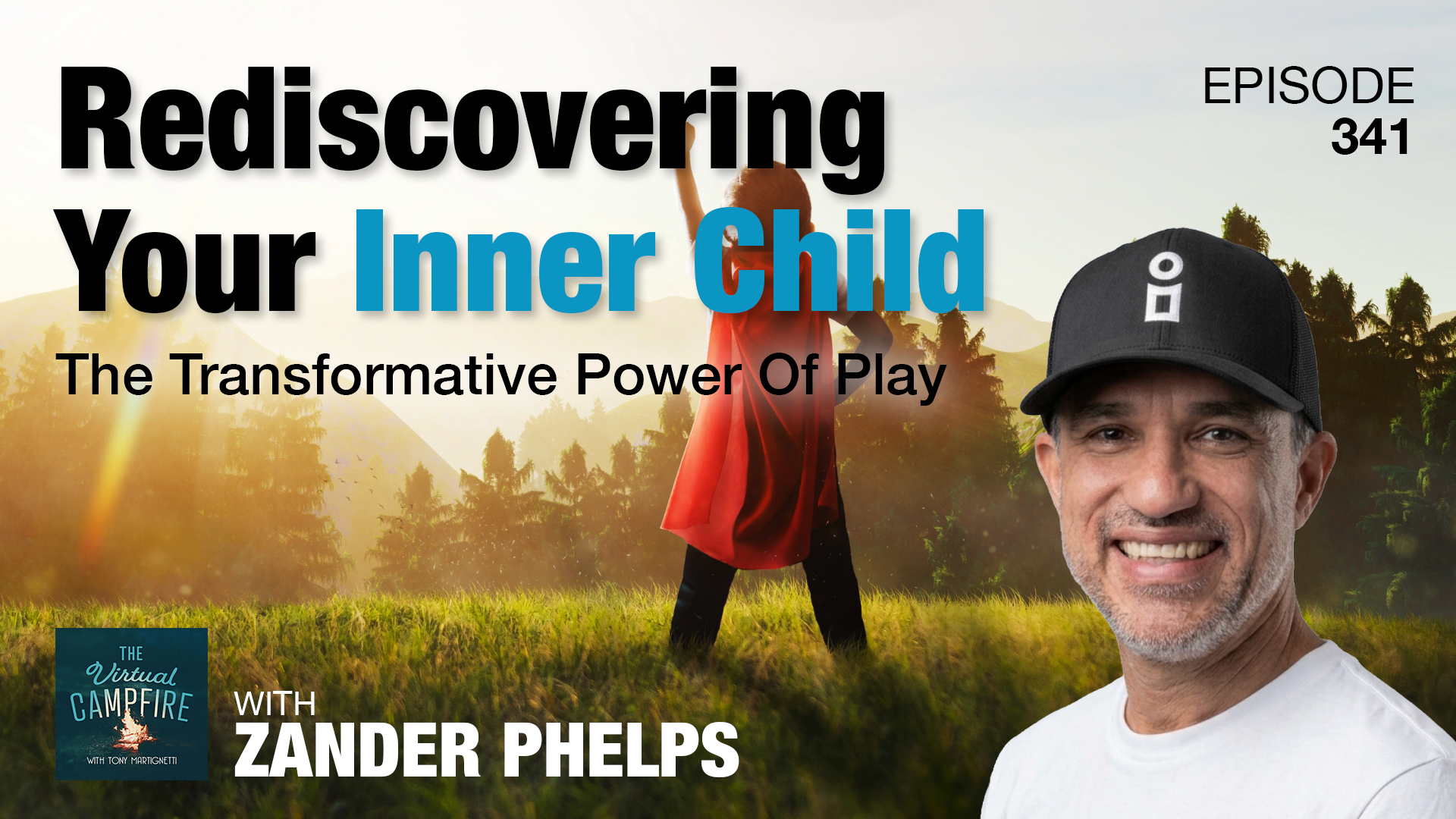
What if one of the most important things we could do to improve our performance, strengthen our relationships, and rediscover our sense of purpose was something we’ve been taught to leave behind?
What if we simply needed to play?
For most of us, play belongs to childhood. It’s what we do before responsibilities take over, before schedules fill up, and before success becomes something we measure through productivity and achievement.
But Zander Phelps sees things differently.
As a lifestyle and wellness coach, keynote speaker, and the creator of the Play Flow State approach, Zander has spent decades exploring the relationship between play, creativity, human connection, and well-being.
His journey began in an unlikely place: a demanding career in television production that brought him extraordinary professional opportunities but left him exhausted and searching for something more.
In this episode of The Virtual Campfire, Tony Martignetti welcomes Zander for a fascinating conversation about walking away from conventional success, discovering unexpected opportunities through play, and challenging the assumptions that keep so many adults disconnected from their natural curiosity.
Their conversation explores the power of small decisions, the courage to follow an unconventional path, and why rediscovering our playful nature may be essential to creating a more meaningful life.
Because sometimes the most important breakthrough begins when we stop taking everything quite so seriously.
Growing Up Means Making Choices
When Tony invites Zander to explore the flashpoints that shaped his life, Zander initially thinks about the experiences that led him to travel the world.
But then he remembers an earlier turning point.
His eighteenth birthday.
He spent it in basic training in the United States Air Force.
For Zander, the experience represented a sudden transition into adulthood. It was a moment when the comfortable expectations of his younger years gave way to discipline, responsibility, and an entirely different environment.
Interestingly, joining the military hadn’t been part of his original plan.
As a teenager, Zander expected to remain in his hometown, find a local job, and spend time with his girlfriend.
His father had another idea.
He encouraged Zander to visit a military recruitment office, suggesting it would provide useful interview experience.
Zander agreed.
What began as a practice interview turned into an enlistment. That unexpected decision would change his life. Although his military experience wasn’t what people might imagine when they think about the Air Force—he describes working underground in a bunker rather than around aircraft—it introduced him to a different world and forced him to grow in ways he hadn’t anticipated.
It was an early lesson in how a single decision can redirect our lives. But an even more consequential decision was waiting for him.
When Professional Success Becomes Personal Burnout
After leaving the military, Zander found himself working in graphic design through an internship with his cousin.
The projects were extraordinary. He encountered work involving Peter Gabriel, Intel, and NBC. What began as a relatively small project for NBC eventually expanded into a major transformation of the network’s on-air presentation.
Zander describes a small creative team working through the transition from analog to digital production, developing new ways to present programming and connect one television show to the next.
It was exciting. It was innovative. And it was exhausting. At times, Zander says he worked approximately one hundred hours a week. He slept at the office. He woke up and returned to work. The creative opportunities were remarkable, but the personal cost was becoming impossible to ignore. Eventually, NBC presented him with an opportunity to continue.
He was invited to outline what he wanted from the relationship, including his plans and financial expectations. For many people, it would have been a dream opportunity. But Zander had reached a breaking point. Instead of writing out his ambitions for the next several years, he wrote a very different message.
“I quit.”
He handed it to his boss. There was no carefully constructed alternative career waiting. No guaranteed income. No detailed plan for what came next. He simply knew he couldn’t continue living the way he had been.
It’s a powerful moment in the conversation because it challenges one of our most familiar assumptions about success. We often believe that greater opportunity should automatically lead to greater satisfaction. But what happens when the life we’ve worked so hard to create no longer feels like a life we want to live?
For Zander, the answer was to walk away. And begin again.
A Backpack, a Footbag, and a Delayed Flight
After leaving his career behind, Zander began simplifying his life. He sold his possessions until nearly everything he owned could fit into a backpack. Then he set out to travel. He had plans to visit Europe, meet his father in Africa, and eventually explore New Zealand and Australia. But just before leaving, a friend handed him a small footbag. Often associated with the game Hacky Sack, it was a simple object that could fit into his pocket. His friend encouraged him to keep it with him.
Zander didn’t think much of the gift at first. Then came a three-hour flight delay. Waiting at the airport, he remembered the footbag in his pocket. Instead of sitting down with a book, he found a corner and started kicking it around.
He wasn’t particularly skilled. He was simply having fun. Before long, another traveller asked to join him. They began playing together, laughing, encouraging one another, and sharing an experience that required no formal introduction. The three-hour delay seemed to disappear.
When their flight was finally ready, an airline employee told them that people throughout the terminal had been watching and enjoying their game. As Zander boarded the plane, fellow passengers smiled and acknowledged him. A frustrating travel delay had become a moment of spontaneous community. And Zander realized something important.
A small act of play had transformed his experience—and influenced the people around him.
He hadn’t needed an elaborate activity, or a common language. He hadn’t even needed to know the people who joined him. He simply needed to begin.
The Universal Language of Play
That airport experience became a turning point. As Zander continued travelling, he brought his footbag everywhere. He played in parks, often barefoot, inviting strangers to join him. Again and again, he discovered that play could create immediate connections.
People who didn’t share a language could still laugh together. Strangers could become friends. An ordinary afternoon could lead to an invitation to dinner or an unexpected place to stay.
Over time, Zander began making his own footbags and giving them to people he met. He eventually developed his own version, which he calls Hacky Dos.
What began as a small gift became a symbol of something much larger. A reminder that connection doesn’t always require conversation. Sometimes it begins with movement, curiosity, and a willingness to look a little silly. Tony recognizes the beauty of this simplicity. A footbag requires very little equipment or space.
Someone can begin playing alone, but the activity naturally creates an opportunity for others to participate. It’s an invitation rather than an obligation. And in a world where so many interactions happen through screens, that invitation feels especially valuable.
Why Adults Forget How to Play
Children don’t need much encouragement to play.
They experiment, invent games,and they laugh.
They explore their surroundings without constantly evaluating whether an activity is productive.
But somewhere along the way, our relationship with play begins to change. School introduces more structure. Competition becomes more important. Professional responsibilities take priority.And eventually, many adults begin to associate play with wasted time.
Zander believes this shift comes at a cost. He argues that play isn’t simply a recreational activity we earn after finishing our responsibilities. It’s an important part of how we connect, think, and engage with the world. In his view, a playful mindset can make people more open to collaboration and more willing to explore unconventional ideas. It can help break down social barriers. And it can create opportunities for connection that formal environments sometimes struggle to produce.
This leads to one of the most memorable ideas in the episode:
Play isn’t the opposite of work. It can be a foundation for doing meaningful work well.
Play, Stress, and the Search for Balance
Zander’s work now focuses heavily on the relationship between play and well-being.
He describes how prolonged stress and burnout can leave people feeling disconnected, exhausted, and unable to think creatively.
His Play Flow State approach encourages people to use playful activities as a way to interrupt stressful routines and reconnect with a more relaxed, engaged state of mind.
Throughout the conversation, Zander discusses neuroscience, stress responses, and the potential benefits of movement, laughter, and social interaction.
He is particularly enthusiastic about activities such as juggling, which he believes can challenge coordination and engage the brain in new ways.
His larger point is that play deserves to be taken seriously as a subject of exploration, even if the activities themselves are lighthearted.
Tony builds on this idea by considering what might happen if people approached important meetings or difficult situations from a more playful state.
Rather than entering a room overwhelmed by pressure, perhaps we could create space for movement, laughter, and curiosity before tackling the work ahead.
Zander suggests even a brief playful activity can help shift the energy of a group.
A moment of movement.
A funny face.
A shared laugh.
A chance to step outside the usual expectations of a professional setting.
The goal isn’t to avoid responsibility.
It’s to create an environment where people feel more connected and ready to participate.
The Courage to Be Different
Zander’s unconventional career path also raises an important question.
How do we continue pursuing something meaningful when other people don’t understand it?
His father initially struggled with Zander’s decision to leave NBC and travel.
From a conventional perspective, it seemed difficult to understand why someone would walk away from such an opportunity.
But after several years, his father began to recognize how much Zander was learning through his experiences.
He came to see travel as a valuable education in its own right.
That shift mattered.
It reinforced Zander’s belief that growth doesn’t always follow a predictable path.
As his interest in play developed into a professional direction, he continued encountering people who questioned its seriousness.
But Zander doesn’t believe his purpose is to convince everyone.
Instead, he focuses on people who are curious enough to explore the possibilities.
Tony recognizes an important lesson in that approach.
An unconventional path can lead to an unconventional kind of success.
But following that path requires the courage to trust something that may not yet make sense to the people around us.
When Curiosity Becomes a Calling
One of the most fascinating aspects of Zander’s journey is how gradually his work developed.
He didn’t begin with a fully formed theory about play.
He began with a footbag.
Then came years of travel and countless experiences connecting with strangers.
He explored juggling.
He became interested in movement, coordination, and the relationship between physical activity and mental engagement.
He began studying neuroscience and looking more deeply at the ways playful experiences influence people.
What initially seemed like a simple hobby gradually became the foundation for his professional identity.
Tony describes this process through an idea that resonates throughout the conversation:
Collect the dots before trying to connect them.
Sometimes we don’t know why a particular interest keeps drawing us back.
We simply know that something about it feels important.
Over time, those interests can begin to reveal patterns.
A hobby becomes a skill.
A skill becomes an area of expertise.
An area of expertise becomes a calling.
Zander’s journey reminds us that meaningful work doesn’t always begin with a business plan.
Sometimes it begins with something we love enough to keep exploring.
What Do You Geek Out About?
As the conversation moves toward its conclusion, Tony asks a deceptively simple question.
What do you geek out about?
What subject, activity, or experience captures your attention so completely that you want to keep learning more?
For Tony, museums and the stories behind art and architecture are examples of that fascination.
For Zander, it’s play.
He has spent decades exploring the subject, and his curiosity continues to grow.
He’s particularly excited about learning more about the brain, laughter, movement, and the potential applications of playful activities.
Their conversation reveals an important distinction between fleeting entertainment and sustained curiosity.
Sometimes the things that bring us joy are also the things that reveal what matters most to us.
But we have to give those interests room to develop.
We have to be willing to explore them without demanding that they immediately become useful.
And perhaps most importantly, we have to resist the temptation to dismiss them simply because they seem unconventional.
Books That Sparked Curiosity
When Tony asks about books that have influenced his life, Zander highlights two very different kinds of reading.
The first is the work of Stuart Brown, whose book on play helped Zander make sense of experiences and observations he’d been collecting for years.
He describes it as one of the rare books that inspired him to highlight passages and return to ideas.
The second is the fiction of Jim Butcher, particularly the Dresden stories featuring a wizard in modern-day Chicago.
For Zander, fiction provides a different kind of value.
It offers enjoyment, imagination, and opportunities to discover insights through storytelling.
And that leads to another fitting observation.
Learning doesn’t always have to feel like work.
Sometimes the most memorable lessons arrive while we’re enjoying ourselves.
Making It Work: Bring More Play Into Your Life
Zander’s journey offers a practical invitation to rethink our relationship with play.
Here are three ways to begin.
1. Carry a Reminder to Play
You don’t need elaborate equipment or a carefully planned activity.
A small object, a simple game, or a playful habit can remind you that opportunities for joy exist throughout the day.
The important thing is to make play accessible.
2. Create Connection Through Shared Activity
The next time you find yourself waiting, travelling, or meeting new people, consider how a simple activity might create an opportunity to connect.
It doesn’t need to be competitive.
It doesn’t need to be impressive.
It simply needs to be inviting.
3. Follow the Curiosity That Won’t Leave You Alone
Think about something you’ve enjoyed for years but never explored seriously.
What makes it interesting?
What could you learn about it?
Where might that curiosity lead if you gave it more attention?
You don’t need to know the destination.
Sometimes collecting the dots is enough.
Key Takeaways From This Episode
- Success Isn’t Worth Losing Yourself Over
Zander walked away from an extraordinary opportunity at NBC because the demands of his career had become unsustainable. His experience reminds us that professional achievement and personal fulfillment aren’t always the same thing.
- Play Is Not the Opposite of Productivity
Play can encourage creativity, collaboration, and fresh thinking. Rather than treating it as a distraction from meaningful work, Zander challenges us to recognize how playfulness can contribute to doing that work well.
- Small Moments Can Create Extraordinary Connections
A three-hour airport delay and a simple footbag changed Zander’s perspective on human connection. Sometimes the smallest, most spontaneous experiences create the most lasting impact.
- Curiosity Is a Powerful Guide to Purpose
What began as a recreational activity gradually evolved into Zander’s life’s work. Following the things that fascinate us—even when they don’t appear immediately useful—can reveal opportunities we never anticipated.
- You Don’t Need Everyone to Understand Your Journey
Unconventional choices often attract skepticism. Zander learned to focus on people who approached his ideas with curiosity rather than spending his energy trying to convince those who had already dismissed them.
- Connection Doesn’t Always Require Conversation
Through his travels, Zander discovered that shared activities could bring together people from different cultures and backgrounds. Laughter, movement, and play can create a sense of belonging without requiring a common language.
- Burnout Requires More Than Simply Taking a Break
Zander encourages people to consider how play, movement, and enjoyable activities might help them reconnect with themselves and interrupt stressful routines. Recovery isn’t always about doing nothing; it can also involve rediscovering what makes us feel engaged and alive.
- Collect the Dots Before Trying to Connect Them
Tony’s reflection captures one of the episode’s most valuable lessons. We don’t always need to know where our interests are leading. Sometimes we simply need to keep exploring, learning, and trusting that meaningful patterns will emerge over time.
The Question to Take With You
What have you stopped doing because someone convinced you it wasn’t serious enough?
Maybe it’s an activity you loved as a child.
Maybe it’s a creative interest you’ve never given yourself permission to pursue.
Maybe it’s simply the willingness to laugh, experiment, and enjoy the moment without worrying about the outcome.
Zander’s story reminds us that a meaningful life isn’t necessarily built by following the most conventional path.
Sometimes it’s built by paying attention to what brings us alive.
By trusting our curiosity.
By allowing ourselves to explore.
And by remembering that play doesn’t have to disappear when we grow up.
Life is too meaningful to spend all of it being serious.
About Zander Phelps
Zander Phelps, known as Z Play Coach, is a lifestyle and wellness coach, keynote speaker, and advocate for the transformative power of play.
Following a demanding career in entertainment production, he spent years travelling and exploring how playful activities can support human connection, creativity, and well-being.
His work includes the Play Flow State approach, footbag activities, juggling, and practical exercises designed to help people rediscover their playful nature.
IMPORTANT LINKS FROM THE SHOW

Zander Phelps’s Links
Zander’s Website
zplaycoach.com
Zander’s LinkedIn
zander-phelps
Zander’s Instagram
zplaycoach
Zander’s YouTube
@zplaycoach