


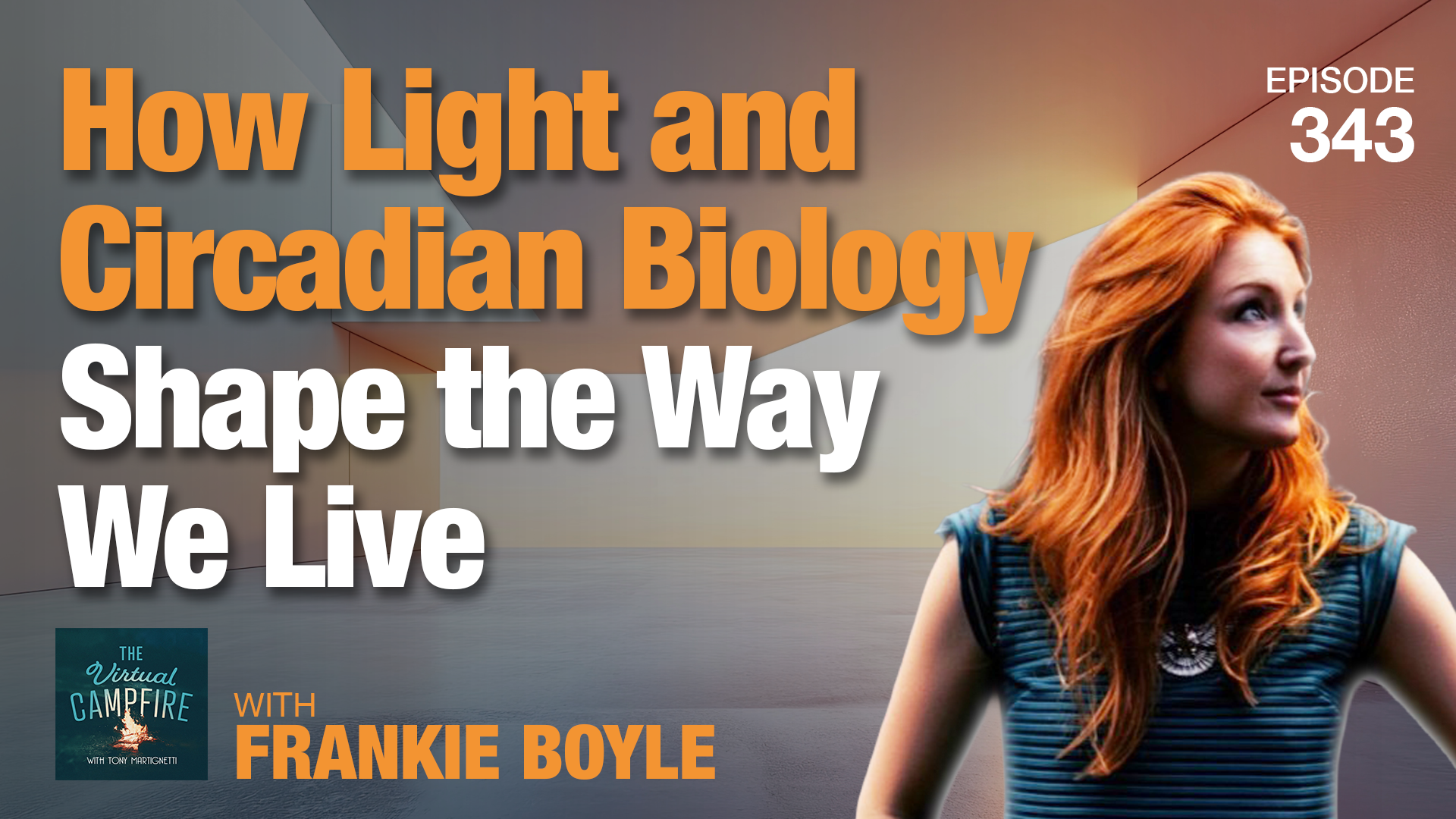
What if the spaces we inhabit are shaping us far more than we realize? And what if the very thing that made you feel different growing up turned out to be your greatest gift?
In this illuminating episode of The Virtual Campfire, Tony Martignetti welcomes experiential artist and speaker Frankie Boyle, whose remarkable journey reveals the unexpected connections between adversity, creativity, neuroscience, and the environments we create.
Growing up with developmental language disorder (DLD) and dyslexia, Frankie experienced the world differently. While language presented challenges, she developed an extraordinary sensitivity to visual information, reading facial expressions, body language, and the subtle signals of her surroundings.
Before she could fully rely on words, she was learning to understand the world through light. That ability would eventually become the foundation of a creative career spanning immersive installations, experiential design, and collaborations with internationally recognized brands, including Samsung, Tiffany & Co., and Burberry.
But Frankie’s journey was anything but straightforward. From being told she would never succeed as a woman in the television lighting industry to losing her professional momentum during the pandemic, Frankie repeatedly faced circumstances that forced her to reconsider who she was and what she had to offer. Each challenge ultimately helped illuminate a new direction.
When Difference Becomes a Gift
Frankie’s earliest flashpoint began with a childhood spent navigating developmental language disorder. While others communicated primarily through words, Frankie learned to interpret the world visually. She became attuned to the expressions, movements, environments, and subtle cues that revealed how people were feeling.
It wasn’t until university that a tutor pointed out something she hadn’t consciously recognized: she was obsessed with light.
Looking back, the evidence was everywhere. She had incorporated fairy lights into her sketchbooks, created colour-coded systems, and instinctively used lighting to help organize her experiences. What had developed as an adaptation to her challenges was becoming a creative advantage.
Her story offers a powerful reminder that our greatest abilities don’t always announce themselves as strengths. Sometimes they emerge quietly from the ways we’ve learned to navigate difficulty.
The Courage to Keep Creating
After university, Frankie took a chance that would change her trajectory. Inspired by the lighting on Strictly Come Dancing, she found the lighting director’s contact information and sent him her portfolio.
To her surprise, he responded almost immediately, inviting her to visit the set. What followed was a six-month apprenticeship and exposure to some of television’s most impressive lighting productions. But the opportunity ended with a devastating message: as a woman, she was told, she wouldn’t succeed in that industry. Rather than abandon her interest in light, Frankie found another way forward.
She moved into art departments, television, film, product development, and eventually the creation of her own artistic practice. Her career became a testament to something Tony recognizes throughout their conversation: courage, resilience, and perseverance. The ability to ask for an opportunity matters. But so does the determination to keep moving when an opportunity disappears.
When the Work Disappears, Who Are We?
By the time the pandemic arrived, Frankie had begun building the career she had worked so hard to establish. She was collaborating with major brands, creating ambitious installations, and finally experiencing the professional momentum she had spent years pursuing. Then everything stopped.
Without the work that had become such a central part of her identity, Frankie found herself asking a difficult question: Who am I without what I create?
Returning to her parents’ home in Kent, she struggled with uncertainty and questioned the value of her work. Eventually, she began looking for a way to make herself useful. Recognizing how many people were suddenly spending their days indoors, she created a series of educational videos exploring how lighting affects our experience of a space. Those videos caught the attention of Google, which invited her to speak to employees about light, well-being, and the environments in which they worked.
An unexpected new chapter had begun. What initially appeared to be the loss of her creative identity became an opportunity to expand it.
The Spaces We Design Ultimately Design Us
One of the most fascinating dimensions of Frankie’s work is her belief that our environments are constantly communicating with us. Light, colour, architecture, and the physical characteristics of a space can influence how we experience our surroundings. A brightly illuminated room may encourage alertness. A softer, warmer environment may feel more conducive to relaxation and connection.
Frankie explores these relationships through artistic practice and her interpretation of research into neuroscience, circadian biology, and human behaviour. Her message is not simply that we should create beautiful spaces. It’s that we should become more intentional about the environments in which we live and work.
Tony connects this idea to the importance of interrupting our patterns. Sometimes stepping outside, experiencing natural light, or simply changing our surroundings can help us approach a challenge with renewed perspective. Rather than always trying to change ourselves, perhaps we should occasionally consider changing the space around us.
Why the Campfire Still Matters
In a particularly fitting moment, Frankie brings the conversation back to the very idea behind The Virtual Campfire. For generations, the sun has signalled the rhythm of the day, while fire has offered warmth, safety, gathering, and connection after dark.
Frankie explores why the experience of sitting around a fire remains so powerful, connecting its warmth and shifting light to our deeply rooted associations with rest, creativity, and belonging. The campfire becomes more than a metaphor.
It represents an environment in which people can slow down, share stories, and connect more meaningfully. And that is precisely what Tony hopes to create through every conversation.
You Were Never Designed to Blend In
Perhaps the most personal revelation arrives when Frankie reflects on the tension between her childhood desire to fit in and her adult ambition to stand out as an artist.
Growing up, she often felt different. She wanted nothing more than to blend into the background. Yet she had chosen a career that required her to make things people would notice.
Working with a life coach helped her recognize this contradiction and begin embracing the identity she had spent years resisting. Her journey reveals that the qualities we once tried to hide can become the very qualities that define our contributions.
As Tony reflects, embracing what makes us different is not always easy, particularly when we’re young and belonging feels like everything. But over time, difference can become a source of creative strength.
Key Takeaways
- Our differences can reveal our gifts. The challenges that shape our early experiences may also help us develop unusual abilities and perspectives.
- Courage creates opportunities. Sometimes the most important step is simply reaching out, asking, or trying.
- Resilience is built through experience. Setbacks can develop the determination to pursue a different path.
- Our environments influence our experiences. Becoming more aware of our surroundings gives us another way to support creativity, focus, and connection.
- Identity is bigger than achievement. Losing the work we do doesn’t mean losing the value we bring.
- Standing out begins with self-acceptance. The qualities that make us different may be the ones we’re meant to share.
A Final Reflection
Frankie’s story invites us to consider two questions.
What if something you’ve spent years trying to overcome is actually pointing you toward something you’re uniquely equipped to contribute?
And what might become possible if you stopped trying to blend into the world around you and began creating the conditions in which you could truly shine?
Sometimes transformation isn’t about becoming someone different.
It’s about finally recognizing the value of who you’ve been all along.
About Frankie Boyle
Frankie Boyle is an experiential artist and speaker working at the intersection of light, environmental design, neuroscience, and human behaviour.
Her creative work includes immersive environments, sculptural installations, and collaborations with major international brands. Through her art and speaking, she explores how our surroundings influence the way we feel, think, and connect.
IMPORTANT LINKS FROM THE SHOW
Frankie Boyle’s Links
Frankie’s Website
frankieboylestudio.com
Frankie’s LinkedIn
frankie-boyle
Frankie’s Instagram
frankie_boyle_studio