
FROM ILLUMINATING HIDDEN BRILLIANCE
An Author’s Note: A Note On the Ideas Behind My Book
Every book stands on the shoulders of the books and thinkers that came before it, and this one is no exception. People sometimes ask where the idea of hidden brilliance came from — whether it arrived as a single insight or accumulated over time. The honest answer is that it has a lineage, and I want to name it, both out of intellectual honesty and because tracing the roots may help you find your own.
What follows is not a comprehensive bibliography. It is something more personal: an acknowledgment of the rivers that fed this work, and an attempt to be clear about where I have borrowed, where I have built, and where I believe this book adds something of its own.
The conviction that the brilliance is already there
At its deepest root, this book belongs to the humanistic psychology tradition — to Carl Rogers and Abraham Maslow and their radical, hopeful claim that human beings carry within them a drive toward growth that needs not to be installed but unblocked. Rogers believed that, given the right conditions, a person naturally moves toward becoming more fully themselves. Maslow gave us self-actualization, and later, self-transcendence. My own phrasing, that illumination is not about adding more but about revealing what is already there, is their conviction, translated into the language of leadership. The light was always the point. They taught me to trust it was already lit.
The parts we exile
If the humanists gave me the faith that brilliance is innate, it was Carl Jung’s depth psychology that gave me the language for why it goes missing. Jung understood that the parts of ourselves we disown do not disappear; they go underground, carrying their energy and their wisdom with them. He called the work of recovering them individuation, the lifelong project of becoming whole rather than merely good, of reintegrating what we exiled in order to be acceptable. When I write about the dimensions we sideline to succeed and insist that those very dimensions hold our hidden brilliance, I am standing squarely in Jung’s lineage. I have simply moved the shadow out of the consulting room and into the boardroom.
The strengths beneath the surface
Closer to the present day, this book is in active conversation with positive psychology and the strengths movement, with the work of those who argued that we grow most not by fixing our deficits but by naming and amplifying what is already strong in us. Amy Edmondson’s research on psychological safety, which I cite directly, sits here too: the recognition that brilliance only emerges in conditions where people feel safe enough to bring it. And I owe a debt to the contemporary argument, advanced by Adam Grant and others, that potential is chronically under-recognized — that what looks like a ceiling is often just a condition we have failed to create. Where I have tried to push beyond this tradition is in scale: positive psychology tends to stay at the individual level, and I wanted to ask what happens when a whole team, a whole organization, reclaims what it has hidden.
Brilliance at the intersection
The bridge between the inner work and the innovation it produces, I owe in large part to Frans Johansson and his idea of the Medici Effect: the observation that the most powerful breakthroughs occur where disciplines, cultures, and ways of thinking collide. This was the piece that let me connect a deeply personal practice to a hard business outcome. Integrating your own sidelined dimensions, I came to see, is simply the individual-scale version of the cross-disciplinary collision that drives innovation across a team. It is how we get from “become more whole” to “and that is precisely where the new ideas are born.”
Wholeness and presence
Running quietly beneath all of it is the contemplative tradition, the long human conversation about presence, integration, and the cost of the divided life. I am indebted to Parker Palmer, whose writing on hidden wholeness and on the danger of living a life split between who we are and how we work is, in many ways, the nearest sibling to this book. The idea at the center of my own framework — that wholeness is the product of integration and presence, not the sum of our accomplishments — carries this tradition’s fingerprints most plainly of all.
If I have added anything to this distinguished lineage, it is not a new river but a confluence. Parker Palmer makes the moral and spiritual case for wholeness. Frans Johansson makes the case for innovation at the intersection. Positive psychologists make the case for engagement with strengths. What I have tried to do in these pages is fuse them — to argue that reclaiming our exiled selves is not only humane but is the very mechanism of innovation in an age of artificial intelligence. That inner wholeness is not a wellness nicety to be addressed once the real work is done, but a strategic capability, perhaps the last durable advantage we have. That, more than any single idea, is what I hope this book contributes.
And yet I would be misleading if I suggested these ideas came only from books. The truest sources were lived. They came from twenty years inside large organizations, where I watched brilliant people quietly fold themselves into smaller shapes. They came from a boardroom moment I will never forget. They came from mountains climbed and glass blown, and museums wandered — from the slow, embodied discovery that the parts of myself I had treated as irrelevant to my work were, in the end, the most relevant parts of all. No theory taught me that. Living it did.
So if you find something here that stops you, that names a thing you have long felt but never quite articulated, know that you are standing in a long line of people who believed the same: that what is most valuable in you was never missing. It was only waiting for light.
— Tony Martignetti
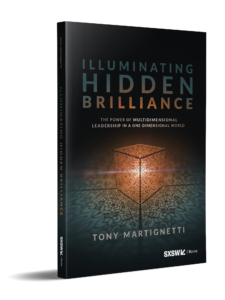
Illuminating Hidden Brilliance arrives November 10, 2026.