


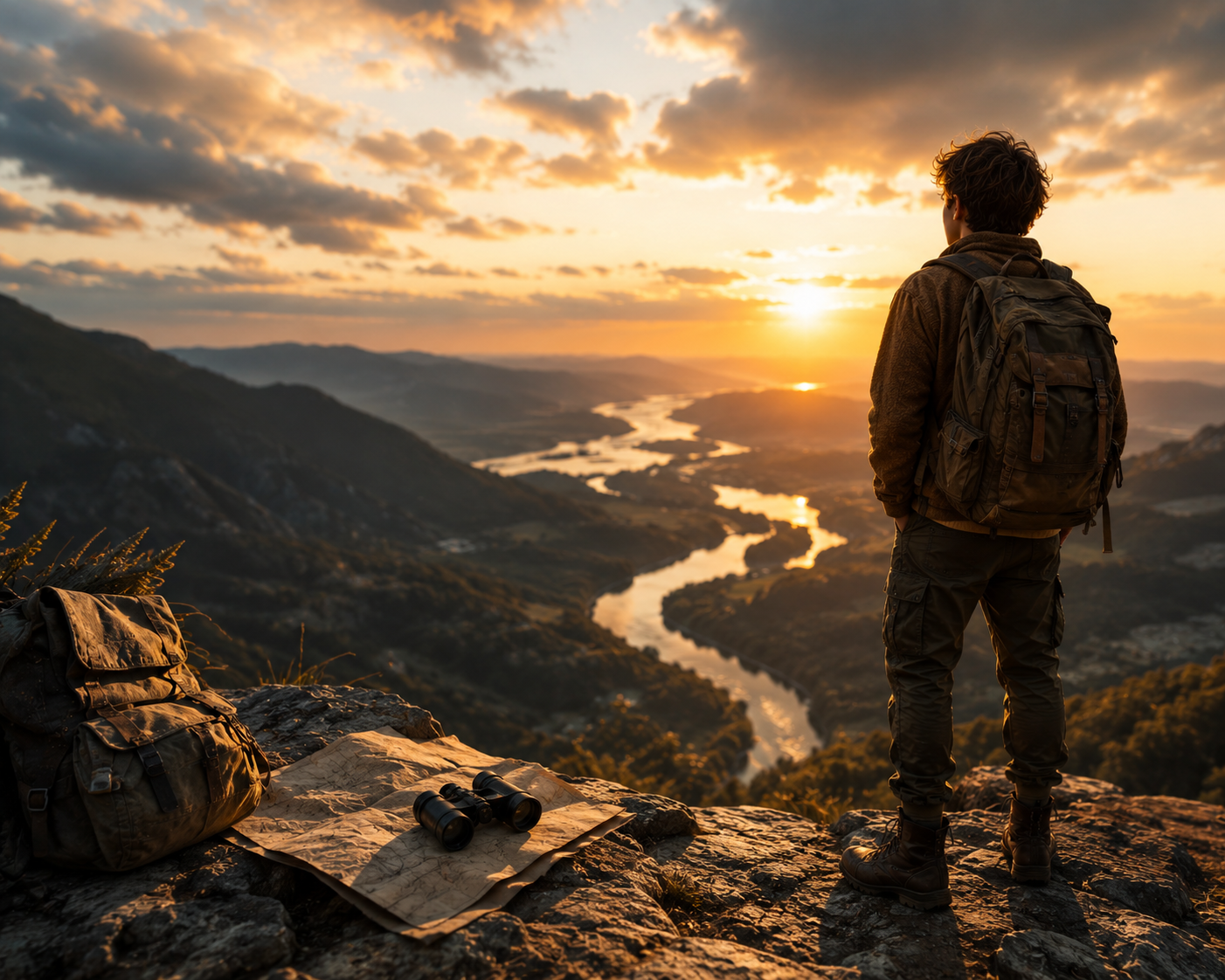
“We shall not cease from exploration, and the end of all our exploring will be to arrive where we started and know the place for the first time.” — T.S. Eliot
The first magazine I ever loved had a yellow border. I was a kid who wanted to be Indiana Jones, and National Geographic was the closest I could get to the feeling: those photographs of places that seemed impossibly far from wherever I was sitting, the sense that the world was larger and stranger and more full of undiscovered rooms than my ordinary living room. The explorer got into me early. It has never left. Decades later, I still organize a surprising amount of my life around the conviction that the interesting thing is always slightly past the edge of what I already know.
So when I heard that National Geographic had opened the Museum of Exploration in Washington, D.C., a hundred thousand square feet devoted to the very impulse that shaped me, I felt the old pull immediately. I have been sitting with one line the museum uses to describe itself, and that line turned out to be the more interesting expedition. They call it a destination for the explorer in all of us.
The Explorer in All of Us
Read that again slowly, because it is doing something radical. It does not say a museum about explorers, those rare and photogenic people who summit the peaks and dive the trenches while the rest of us watch. It says the explorer in all of us. It takes the thing I spent my childhood believing belonged to a heroic few and relocates it into everyone, including the accountant who will visit on her lunch break and the ten-year-old dragged there on a school trip. The museum’s whole premise is that exploration was never a profession reserved for the intrepid. It is a capacity, a standard human dimension.
That distinction is the reason a museum ended up teaching me something about leadership. Most of us do the opposite. We treat the explorer as a foreign concept. We decide, somewhere in the transition from the kid who wanted to dig up lost cities to the adult with a title and a full calendar, that curiosity is a luxury for the young or the unburdened, and that our actual job is to know things, to have the answer, to project the settled competence the role seems to demand. The explorer in us does not die. It goes quiet, filed away with the other dimensions we concluded the workplace had no use for.
Where the Explorer Goes to Hide
Here is what that costs. The explorer is the part of a leader that can walk into uncertainty, a market that just shifted, a problem no framework quite fits, a future nobody can see clearly, and feel something other than dread. The explorer treats the unknown as terrain to be mapped rather than a threat to be managed. When that dimension is dormant, uncertainty reads only as danger, and a leader facing it reaches for false certainty, a premature decision, a borrowed playbook, or the confident answer that ends the discomfort but forecloses the discovery. When the explorer is awakened, the same uncertainty becomes the most interesting room in the building.
Joseph Nunes and Wendy Heimann, who study what makes immersive experiences work, found that people feel pulled into a place when it answers six questions for them almost without their noticing. Where am I? Who am I with? What can I do? What is happening? Am I making progress? Why does this matter? That is the explorer’s method too, turning any unfamiliar room, a market, a merger, a reorg, into terrain instead of a threat.
The National Geographic Society describes its own mission as using science, exploration, and storytelling to illuminate and protect the wonder of our world. That phrasing stopped me. Illuminate and protect. You cannot protect the wonder if you have stopped feeling it. And you cannot feel it if you have retired the part of yourself whose entire function is to be astonished, to want to know what is over the next ridge. A leader who has exiled their own explorer has not become more serious. They have become less awake to the very thing that makes hard work worth doing.
What This Actually Looks Like
So the invitation the museum makes to a ten-year-old is exactly the one I would make to you, and it has nothing to do with buying a plane ticket. Integrating the explorer is not about adventure travel or a bolder bucket list. It is about how you show up in the room you are already in.
It looks like walking into your next impossible problem and asking the explorer’s question before reaching for the one that ends the discomfort: what is actually here that you have not seen yet. It looks like treating a shifting market as a coastline to be charted rather than a storm to be survived. It looks like letting yourself be genuinely curious about the person across the table whose view you were about to dismiss, because the explorer assumes there is undiscovered territory in them too. It looks like protecting one small pocket of your week for the reading, the conversation, the tangent that has no immediate use, the way a yellow-bordered magazine once let the world get bigger.
The explorer was my first archetype, the one I reached for before I had language for any of it. What the museum reminded me is that it was never mine alone, and it was never really about faraway places. It is a way of meeting the unknown, and the unknown is not off in some jungle. It is in your next quarter, your next hard conversation, your next decision made without enough information. You do not have to become an explorer. You already are one. The only question is whether you will let that part of you back into the room where the real expeditions happen now.
Somewhere there is a kid turning the pages of something, letting the world get larger. Lead like you remember being that kid. The territory is still out there. It just looks different now.
If this sparked something for you, a new question, a new perspective, or a quiet knowing, you don’t have to explore it alone.
Join my newsletter
Or book time to connect.