


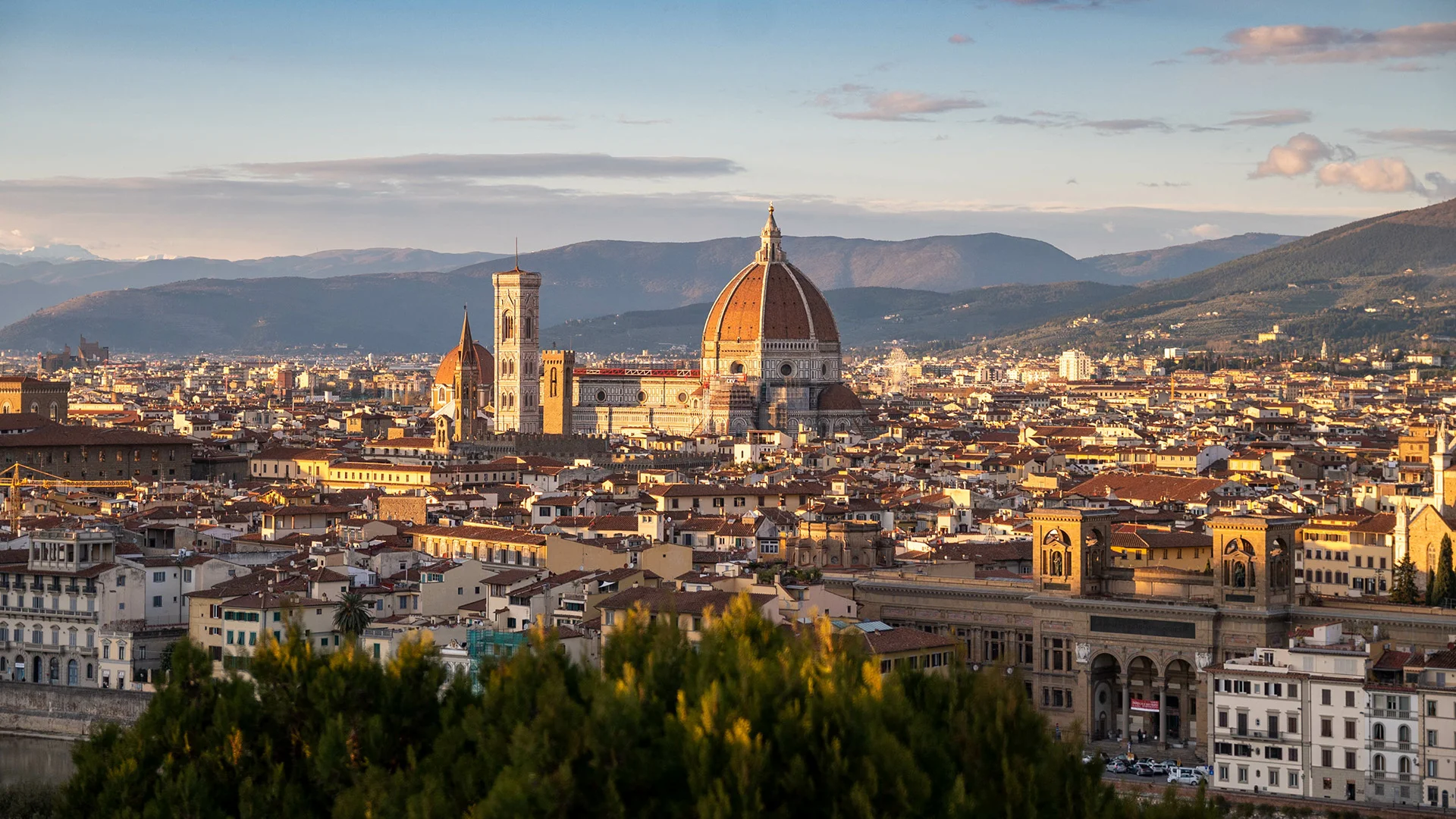
In 1418, the city of Florence had a 100-foot hole in the roof of its cathedral and no idea how to close it. The builders had started Santa Maria del Fiore more than a century earlier and left the hardest part for later, gambling that someone, eventually, would work out how to raise the largest dome since antiquity over an octagonal base, without the flying buttresses every other cathedral leaned on and without a scaffold tall enough to hold it up mid-construction. Later had arrived, and nobody could do it. The credentialed architects of the age, the men whose entire profession was buildings, were stumped.
The man who solved it was a goldsmith
Filippo Brunelleschi had no formal training in architecture or engineering. He had trained in metalwork, dabbled in clockmaking and gears, worked out the mathematics of linear perspective, and spent years in Rome obsessively measuring the ruins of the Pantheon. He was, by the standards of any org chart, catastrophically unfocused. And that scattered inheritance was precisely what let him see what the specialists could not: that a dome could be built as a series of self-supporting concentric rings, laid in a herringbone brick pattern he almost certainly absorbed from studying Roman work, hoisted by machines he designed himself because the machines that could do the job did not yet exist. The problem that defeated the experts yielded to the person who had refused to become only one thing.
We tell the story of Renaissance Florence as a mystery of concentration: how did one small city, in one narrow window, produce Brunelleschi and Donatello and Botticelli and, a generation on, Leonardo and Michelangelo, an improbable density of genius the world has never quite matched since? The popular answer, and the one founders have been sold for a decade, is proximity. Put brilliant people close together and magic happens. It is a comforting story, and it is half true in a way that has quietly misled a generation of company builders.
Proximity was the setup, not the punchline
Frans Johansson gave this phenomenon its modern name, the Medici Effect, arguing that breakthroughs cluster at the intersection where disciplines and cultures collide. He is right, and the framework has earned its influence. But the version that filtered into startup culture got flattened into something softer than what actually happened in Florence, a vague faith that open floor plans and cross-functional standups will summon serendipity on their own. Sit near someone in marketing, absorb their worldview by osmosis, innovate. The history says the mechanism was harder-edged than that. Proximity was necessary. It was nowhere near sufficient.
What Florence had that a coworking space does not was structured friction, collision made mandatory rather than left to chance. The bottega, the Renaissance workshop, was the engine. It was not a room where a painter happened to sit beside a sculptor. It was an operation where a single commission, a bronze door, an altarpiece, a dome, forced a goldsmith, a mathematician, a carpenter, a blacksmith, and a stonecutter to solve one problem together, their outputs physically dependent on one another. Verrocchio’s workshop, the one where a teenage Leonardo apprenticed, produced paintings, sculpture, goldwork, tomb monuments, and theatrical machinery under one roof, which meant an apprentice couldn’t specialize his way out of contact with four other crafts. The disciplines didn’t mingle politely. They were fused by the work.
Then there was the competition, and it was brutal in a way modern culture has largely engineered out of the workplace. The dome commission was decided by public contest. When the overseers finally handed Brunelleschi the job, they did something that would make any modern HR department flinch: they appointed his bitter lifelong rival, Lorenzo Ghiberti, as co-superintendent, and paid them the same wage. The two men had hated each other since losing and winning an earlier competition seventeen years before. The patrons knew this. They forced the pairing anyway, because they believed rivalry under one roof produced better work than comfort ever would. They were manufacturing friction on purpose.
What this actually means for a company
Strip the romance away, and Florence offers founders a principle that runs directly against how most modern companies are built: innovation is a function of designed friction, not headcount. The instinct when a company wants more innovation is to hire more people, usually more specialists, and to reduce friction in their path so they can move fast. Florence suggests the opposite on both counts. The city did not out-hire its rivals; several were larger and richer. It out-collided them. And it did so by building institutions whose entire purpose was to put unlike minds in unavoidable contact and keep a competitive charge running between them.
The modern trend line points the other way, which is what makes this urgent rather than merely historical. Remote and distributed work, whatever its considerable virtues, is a friction-removal machine. It is superb at letting a specialist do focused, solitary work and terrible at generating the unplanned collision, the overheard problem, the argument in the margins of a shared task. We have optimized for the individual contributor executing in isolation, and in doing so we have quietly disassembled the bottega. Add the way AI now lets each person complete more of a task alone, without needing anyone else’s craft to finish it, and the collisions grow rarer still. The structural drift of the entire modern workplace is away from the exact conditions that made Florence what it was.
So, the founder’s job is not to wait for serendipity. It is to engineer the collision that distributed work has removed. Concretely, that means designing shared problems that cannot be solved inside one discipline, the way a bottega commission couldn’t, so that the engineer and the designer and the person who talks to customers are forced into the same unresolved question rather than handed clean, separable tickets. It means bringing people together in person for the specific, high-friction work of wrestling with a hard problem and being willing to let those gatherings be productively uncomfortable rather than smoothing them into consensus. And it means treating a little rivalry and open disagreement not as a culture problem to be mediated away, but as a resource, the Ghiberti principle: the tension between two people who see the same problem differently is often where the better answer is hiding.
The part of the story we shouldn’t romanticize
There is a shadow to the bottega that founders should sit with, because it is the honest half of the lesson and it protects you from copying the wrong thing. The Renaissance workshop was also a machine for erasing individual contribution. Credit flowed upward to the master whose name carried the workshop’s market value. When Ghiberti’s Gates of Paradise were unveiled, the twenty-odd assistants who cast, chased, and polished those panels were dissolved from the record. The system generated extraordinary collective output partly by making the individuals inside it invisible, and the young talent that fed it did so under real economic vulnerability dressed up as tradition.
That is the cautionary note. Designed friction produces breakthroughs, but the same structures that force brilliant collision can just as easily bury the people generating the brilliance. A founder who takes only the first lesson, forces the collisions, and ignores the second, makes sure the people inside the collision are seen and credited, will build something productive and extractive, and the most talented people will feel themselves disappearing into it. The full lesson of Florence is both halves at once: engineer the friction and refuse the erasure. Manufacture the collisions the way the Medici’s city did, and then do the one thing the bottega never learned to do: let every person in the room keep their name.
Brunelleschi got his name on the dome, and it still stands six centuries later, the largest masonry dome ever raised. He got there because a whole city was built to throw a goldsmith at an architect’s problem and see what happened. Your company will not summon that by accident, and it will not summon it at all if everyone is heads-down and alone, executing clean tasks a machine could have scoped. The genius of Florence was never in the air. It was the architecture that made the collisions unavoidable, and the founders who want what Florence had will have to build that architecture on purpose, because nothing about the modern way of working will build it for them.
If this sparked something for you, a new question, a new perspective, or a quiet knowing, you don’t have to explore it alone.
Join my newsletter
Or book time to connect.