
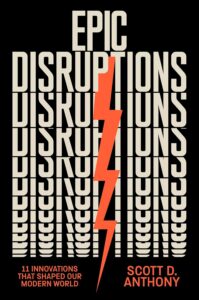
Disruption is everywhere—but few truly understand how it actually works. In this episode, we sit down with Scott Anthony—Clinical Professor at Tuck School of Business at Dartmouth College, Thinkers50-ranked global thought leader, and author of Epic Disruptions: 11 Innovations That Shaped Our Modern World—to explore the real story behind disruptive innovation. From his early days at Dartmouth College to working alongside Clayton Christensen, Scott shares the defining flashpoints that shaped his career, the importance of pursuing non-obvious opportunities, and the human behaviors behind breakthrough ideas. Through powerful stories—including insights on Julia Child—we unpack what it truly takes to navigate uncertainty, persist through challenges, and thrive in a world defined by constant change.
—
It is truly an honor and a pleasure to introduce you to my guest, Scott Anthony. Scott is a clinical professor at the Tuck School of Business at Dartmouth College, where he focuses on the adaptive challenges of disruptive change. Scott’s latest book is Epic Disruptions: 11 Innovations That Shaped Our Modern World. Amazing book. He is the Thinkers 50. They have named him the world’s fifth most influential thinker in 2025 and the world’s leading innovation thinker in 2017. He lives in Brookline with his wife and three kids, who are living in the house, and one of whom goes to school nearby at Boston University. It is truly a pleasure and an honor to welcome you to the show, Scott.
Tony, I am really pleased to be here. I am looking forward to our conversation. I am sure it is going to be a fun one.
Me too. We have the fire blazing. We are getting things started, and I am looking forward to just diving into your journey as well as all of the things that you speak about, you write about. You have just got a prolific career that you have really come to at this point, and you still have a lot more to go. We are going to dive into your thought leadership, but we are going to start with your journey first and foremost.
Let us do it.
We are going to do this through what we call flashpoints. Flashpoints are the points in your journey that have ignited your gifts into the world. You can share what you are called to share, and you can start wherever you like. Along the way, we will pause and see what themes are showing up. Are you ready?
I am ready.
Scott, take it away.
The place where I am going to start is my first year as an undergraduate student at Dartmouth College. Walking into Robinson Hall for the first time. Robinson Hall is where the Dartmouth, the daily college newspaper of Dartmouth College, was published in 1799. Why was I going in there? I had a commitment to myself when I went to Dartmouth. I was very happy to be going to Dartmouth, a great Ivy League school, but I was not stupid.
The reason I got into Dartmouth is that my dad went there, and my older sister went there. I was a legacy at a time when being a legacy was a good thing. I was a fine student in high school. I got good grades and had good test scores, but my resume was barren. My big thing was that I was the co-founder of the Young John Madden’s fan club, which those of a certain age will recognize the name. He was a football broadcaster. It was my friends and I getting together to watch football.
This is not a sterling resume, and I deservedly got rejected at Harvard, Stanford, Cornell, and wait-listed at MIT, but I got into Dartmouth. Anyway, I was looking for something to do to spend my time and develop a passion for. I tried a bunch of things. I went into Robinson Hall and went to the newspaper. It clicked and connected the process of being given a question, having to quickly come up with an answer, generating data, telling a story, and then running a business when you are trying to be part of the leadership team of a newspaper.
All of that really connected deeply with me. That started me on the journey to be a consultant first, a writer along the way, and a teacher now. That moment of connection with all the things that go into a newspaper. It makes me nostalgic and sad for what has happened to the newspaper industry. It reminds me, last thing for this one at least, of a lesson about disruption. Disruption, I of course believe in its power and its promise, but there is a dark side to it as well. Things get lost when disruption takes hold, like newspapers.

There is something about the nostalgia that you have. Sometimes you have nostalgia about things like tapes, cassette tapes, mixed tapes that used to be made when we were younger. I am really feeling this sense of connection to journalism in general, which I think is such an amazing career. I have interviewed more journalists than I care to mention on this show, who used to be journalists, and then they eventually get into other fields.
There is something about the skill set that you develop in that field where you start. You become very curious, and you start with a thesis, a question that propels you down this path of really investigating deeply. I know not all of journalism is that way. Some of it is a little bit less flashy, but it really starts with an investigation into a deep inquiry. Would you agree?
I totally agree. I remember there was the first editor I really remember, David Herszenhorn, who went on to work at the New York Times and Politico and has done lots of things. He said, “Let me explain what a journalist is to you.” In 1993, there was a bombing in the World Trade Center. The truck goes underneath, and a big bomb goes off. This is before the terrorist attacks on the top of the buildings.
There is a big gaping hole in the building. Normal people run away. Journalists run to a journalist and say, “I want to figure out what the story is. I want to figure out what is going on.” It is as you describe, it is that curiosity, that burden, desire to figure out what is going on beneath the surface. What is truth? What is reality?
Back in the days when I was doing a lot of recruiting for the consultant company in which I used to work, there were a couple of things on a resume for college that would be almost an automatic interview. I saw somebody very actively involved in their student newspaper, an automatic interview, somebody who was on the swim team.
Also, an automatic interview because I learned I am not a swimmer, but I have members of my broader family who are. You have to work so hard and be so committed to be a collegiate swimmer that if you do it and maintain reasonable grades, I know that your work ethic is off the charts. Journalism and swimming were the two easy passes into an interview.
I can attest to that. My cousin was an Olympic swimmer. I definitely feel the sense of the morning swims, the afternoon swims, all day long, it was doing the schoolwork, but also doing the practice. It was a big deal.
It is so self-motivating, too. It is like you play a team sport, the team is there, but in swimming, it is you in the water, and you just have to commit to doing the things to work. We could go on about that for a long time, but there is something about that. People who are distance runners, it is the same thing. Yes, you have got other humans around you, but it is you and your feet and the miles as they unfold.
Let us talk about the next flashpoint that really came up for you. Here you are entering the hallowed halls of Dartmouth, finding this interesting field, but what happens next?
The moment that I would next pick up is an accidental thing. A few years after this, I was applying for jobs, and I did what many people did. I studied economics. What do you do if you study economics? It is consulting and investment banking. I am filling out an application for McKinsey, and they say, “What offices do you want to work in?” I had not really thought about it that much. I put Boston, and I put Washington, DC.
I was originally from right outside of Washington, DC, and I’m particularly nothing against it. I want to go back there, but I do not know. I just wrote it down. That moment was a life-changing moment. I ultimately got a job at McKinsey. I worked in the Washington DC office. The reason why it was so important is that at the time, if you were a business analyst, which is what you do right after an undergraduate degree, and you are in the DC office, you have the opportunity to spend a year working for the McKinsey Global Institute, which is McKinsey’s internal think tank.
I was approached early on in my tenure, saying, “Are you interested in doing this for your second year?” I said, “Sure, why not?” It felt like a different experience. I was 22 or whatever, who knows what I was going to do with my life. That ended up taking me to London because they did a study on growth and productivity in the United Kingdom. I was shipped off to London in the fall of 1997, where I was for ten months, did an in-depth research report, and wrote an in-depth paper, which was another thing that advances me towards long-form writing.
Most critically, I met my wife during the time there. That small moment of writing down that office, again, without too much thinking, I do not know if it is quite a sliding doors moment, but it set me down a path that had a couple of really important things that happened in it. That is the next flashpoint that I think about.
When you hear opportunities to do weird things, pause. Many times, those are the things you ought to do.
What I love about that is you just have to be open to seeing where these threads take off. You never know what is going to happen. Even if you are questioning it, it is just like letting go of what the outcome could be because it is going to open new doors to new possibilities. There is the ever-asked question of what is the worst that could happen if going to London or going to Washington DC, you can always figure out a new path, especially when you are a young chap. You will figure out a new path eventually.
I totally agree with that. That is a piece of advice that I repeatedly give my students. When you hear opportunities to do weird things, pause. Many times, those are the things you ought to do. For me, going to London is an easy thing to say yes to, but it was off the beaten track for what people did at McKinsey. It is a recurring theme. There were a couple of other times during the years that would unfold where I did the thing that was not obvious. The thing that was not obvious is ultimately what made me who I am today and was the most fun. The non-obvious things are the degenerative ones.
I am sure we are going to get into this later because I know a lot of the ideas in your book really talk to these things that are not obvious or that really are not typically thought of, and they are disruptive. At the end of the day, I think it is good to see how in your own life you have experienced some things that disrupt you, but if you did not do them in the first place, then where would you be? You probably would have taken the more traditional path, and that traditional path may not have been as rewarding as trying might have been.
You cannot argue the counterfactual. I am happy with my life, so I have nothing that I regret in those big decisions. The thing that goes through my mind, Steve Jobs from Apple was once asked about creativity. He said, “If you ask a creative person how they did it, they often feel a little guilty because creativity is nothing more than connecting things, putting pieces together.”
Creativity is nothing more than connecting things, putting pieces together.
The great thing about going off the beaten path, living in a different country, working in a different industry, having a different experience, you have feedstock. You just have different lenses that you can mix and match to see things in different sorts of ways. I feel like that has been the great gift of my life has been the ability to get these different lenses to see things in different ways.
Well said. If there was one more flashpoint you wanted to share, which I am sure there are, what would it be once you have now you have got this experience, you have gotten into London? I know you eventually lived in Singapore. Is that the next flashpoint?
That requires two. I will do the first one, and we can talk about the same for one, if you have room for a fourth. The next one would be in the fall of 2000, which is 26 years ago. I am a second-year student at Harvard Business School, at a moment when you need to start thinking about what you are going to do after graduation.
I am sitting in a class called Building and Sustaining a Successful Enterprise that is taught by Clayton Christensen, who, now would be viewed as a business legend, at the time was someone who had written a book called The Innovator’s Dilemma, but not someone who had quite broken through to be the rock star that it ended up being.
He said about midway through the class, he said, “I have got some funding from the dean, and I have got the ability to hire a researcher or two. I cannot promise that you are going to make as much money as your classmates. In fact, you are likely to materially depress the average starting salary of your class, but I can promise that it will be an interesting experience.” I was sitting there saying, “I did not want to go back, no disrespect to McKinsey.
I had done a summer internship at a software company that did not speak to me. I had a job offer at American Express that I, who knows, what would have happened had I taken it.” Nothing that I said to your point before that I could not go back and do again if the time with Clay ended up not working out. I said, “Let us do it.”
I was loving his class. I had read the innovator’s dilemma on a flight to Phoenix when I was going to see Pearl Jam with my friend, Chris Cow, which is a whole distracting story. I love the ideas. When else would you get the chance to work with an academic like that, shaping ideas? I ended up doing two years of work with him.
He had founded this consulting company, Innosight, with my former colleague, Mark Johnson. Before all this, I ended up joining that team in 2003, and the rest is history. Seven years in the US with Innosight, twelve years in Singapore with Innosight, before coming back to the US and transitioning to teaching. That moment where the possibility of really going deep on the topic of disruptive innovation, that is the moment where the rest of the path begins to unfold.
First of all, wow. This is so amazing when you think about it, because Innosight, the whole organization has been, I have been following the work for so long, it is very well researched. Kudos to you. Well researched, very interesting insights that have come out of Innosight. It is so interesting how that path really does speak to who you have been, being in journalism, being that person who does not want to just necessarily do the same old same old, but to be able to do the research, go deep. It just feels like it is such a great job for you. Looking in hindsight, knowing that it was with Clay, this is a dream job for a lot of people who are business thinkers and thought leaders to be able to study at the feet of one of the greats. What a wonderful experience.
It was also at a time when he had written The Innovator’s Dilemma. It was an incredibly well-received book, but he had only done that. He had not quite achieved mega-star status, which meant he had something that he would not have ten years later, which was time. I had the ability to actually spend real time with him when we were working on our book, seeing what was next.
It is a very distinct memory. I learned Clay was great at many things, but he did not always do homework. If I had a meeting on Wednesday, and I gave him pages to read on Monday, he had other things going on. He would not really read them. I would book an extra-long time with him, and I would go, and I would give him the pages, and then I would just go sit outside and wait.
He would go and dutifully read them and mark them all up, and then we would talk about it. I still have saved, I have saved one page, usually covered in ink. It is just lots of comments and feedback. I look back at seeing what is next, and the writing is dense. There was one time I gave him a page, and he wrote on the left side of the page, “This is perfect.” That was iteration number, I do not know, a very high number for that particular thing. That was a treasured memory.
Anyone who gets that it is like, “Holy moly.” When you get it and you see it coming from someone like that, it is just really meaningful. I hear that I would save it. You decided to leave Innosight and go to Tuck, and the rest is history. That is it, we are closing up shop.
That was not an overnight decision. In fact, that decision, my wife would say, took you sixteen years to actually act on it. In 2006, I said, “I have enjoyed this, but I really would like to be an academic.” My grandfather was a professor for 40 years at what we would, my Dean Matt Slaughter would call, the Tuck of Alston, Massachusetts, or the Harvard Business School. My grandfather taught there in 2006. I started working on my application to get a doctoral degree from HBS. I got in, my Innosight colleagues said, “Please do not go.”
I said, “Not yet, but I am going to do it next year.” I had to reapply. I got it again. We had a retirement party all set for me to leave. In July 2008, I said to my wife one morning in Denver, Colorado, visiting my sister, “I just do not think I want to do this.” There is something about it that just did not sit right. I can look back now and say, “I understand it.” Teaching, I love. I love being in the classroom. I love trying to share ideas with students and really shape ideas with students.
The academic research through a peer-reviewed journal, I am incredibly thankful that I have brilliant colleagues who go and do that phenomenally well. It is not what gives me energy. I like doing applied research. I like looking for the insights that you can share with executives that would never make it through a peer-reviewed academic journal. I started the journey to leave Innosight in 2006, and it took me until 2022 to actually execute it. It is a pretty slow exit process.
It is great, though, you have this, as you said earlier, it comes from this idea of experience. The more experience you have, the more you can almost set the tone for what you want to do next. When you are early in your career, you just follow whatever feels right, but now it is a little more informed. It is almost like what we say about intuition. Intuition is not just about feeling like you are just following your heart, but there is a little more to it than that. It comes from inner knowing that is coming from more experience, and at this point, you say, “I know what my heart or where I want to take this.” It sounds like that is what was really unfolding at that point.
The people at Innosight are great. I wish them nothing but success. They are doing great work still out in the field. I am in the right place now, teaching the consulting work. I was always a weird consultant in that what gave me energy was more the research part of consulting, where a client would present a problem, where you say, “Not only am I not sure of the answer, I am not sure how we are going to approach the problem.”
You have got to figure out the method before you figure out the answer. Those are the things that gave me energy. Coming up with lasting relationships where you shook clients down for lots of money, which is what powers a lot of consulting, of course, in a nicer way than that. That was not the source of energy for me.
It was going to find the next problem, which made me along some dimensions bad because I would want to hop from client to client because I am looking for different problems and different frontiers, and the best revenue generators are those that go really deep and develop a network of relationships with one client. I have plenty of lasting relationships with people that I worked with, friends, and clients that became friends, but it was again, skipping around a little bit. Again, I ended up where I was supposed to end up, I think.
This leads us to the thought leadership that you have really tapped into, which is disruptions at the core of a lot of the work that you have been doing, but let us talk about epic disruption. This book, when I read it, I was like, just first of all, fascinated by some of the stories that you, they are not the ones that I would typically expect to hear about. I was just really fascinated as a good read to have interesting stories, because that is what we want to hear, a good story, but also a great lesson coming from it. I just would love to hear in your own words what it is about this book that fascinated you, and what we should be taking away from it.
Tony, here is a little story about the origins of the book that helped to explain it. The book was not my idea. This is my ninth book. Every other book followed the same process, which is you have an idea, you write a proposal, you give it to a publisher, you shape it, and that creates a book. This time, I had a proposal. I shared it with the publisher.
The publisher said, “Interesting idea, but we have got one for you.” Harvard had just been talking in 2022. It was their 100th birthday. They named four ideas that shaped the modern business world. Scientific management, emotional intelligence, shareholder value, and disruptive innovation. They said, “You have spent your career on disruptive innovation. What about doing a history book that uses deep history as a lens to look at what is going on right now?”
My first answer was no, that is not the book I want to write. It was over the weekend. I just could not get it out of my head. For everything that I have written about disruption, there are a bunch of open questions. People misunderstand it. I cannot always explain it. Some parts of it are super easy. Maybe Kevin Evers, my editor, is right. Maybe I should give it a go. I started working on an outline. I am like, this is fun. Let us do it.
I am so glad that I did because what I learned from it is that the timeless stories that you find when you go back and do deep research have incredibly timely messages for the fiercely urgent moment that we are in right now. That connection point between the past, present, and future, I think, is really powerful. That is what the book aspires to do. It aspires to give gripping stories, as you described, that illustrate patterns that have principles underneath them that you can use to make sense of what is going on right now.
It is wonderfully set. In many ways, and this is going to be so tongue-in-cheek, you are being disruptive about a book about disruption. That is really a fun, meta way of looking at it. It delivered on that promise.

I appreciate that. It was a joy to write, like every book, as I said, this is my ninth. The first version is rough. In the second version, you can almost see it, and then something happens between the second and third versions, and the third version is publishable. The same was true for this. The first version was messy. The second version is like, “Not bad.” The third version, “I think we got it.” That is great support from the team at Harvard and some really good friends who provided incredibly helpful feedback, including thankfully killing a version of the conclusion I had, which I loved.
I had this whole chapter of speculative fiction about what my world and my kids’ world was going to look like in 2040 as disruption took hold. It was so fun to write, and five out of five people that I sent it to said in reasonably polite terms, “This is horrible. Please do not publish this.” I scrapped it and started over. It is nice to have friends who will be honest with you.
Maybe you can secretly release that to people.
I do. It is on my hard disk, and there is a footnote in the book that says, “If you want to read it.” So far, I think eight people have emailed me, and I have sent it to eight. So far, all of those eight have said you made the right call, having the conclusion that you had in the book. We are now up to thirteen universal data points that all agree that the speculative fiction did not quite deliver the way I thought that it would. Someone at some point is going to say you nailed it, Scott. I do not know. We will wait for that one.
For the sake of listeners who have not read the book, maybe you want to share just one story and summarize it for the sake of brevity, but share like one of the stories, maybe the one about Julia.
I knew you were going to say that. I always go through my head because I have got my favorites and all that, but Julia Child, it was the last chapter that I wrote, and it is such a fun story. First, people are like, “What is she doing in a book about disruptive innovation?” Before she wrote the book, Mastering the Art of French Cooking, if you wanted to enjoy great French food and you lived in suburban America, what did you do? You did not really have much choice.
You could maybe go to the biggest city. They might not have great French food. You had to get on a plane or take a boat to go to France. She democratized cooking and continued to do that through her books and through her television career to allow a broader population to be able to enjoy food, which is exactly what disruptive innovation is. You have that.
It is an unexpected story of disruptive innovation. The thing that I love about the Julia Child story is that it highlights one of the key messages in the book. People sometimes think that disruptive innovators are superheroes who have superpowers. Julia Child shows that it is normal for people to follow a very particular set of behaviors. She was born in 1912 in Pasadena, California. She was not born a great chef.

Nobody is. In fact, the records show she was a pretty bad chef early in her life. The first dish that she cooked for her husband, Paul Child, was brains simmered in red wine sauce. Why? I have no idea. Even in her memoir, she said it was a disaster. She arrived in France in 1948. She goes to this lunch that I call in the book, the meal that changed everything, where she just falls in love with French food. She commits to becoming an excellent cook.
She follows these behaviors. She is curious, seeking to learn. She is collaborative. She finds other people with whom she can work. She is customer-obsessed. Once she starts working on the cookbook, she puts herself in the shoes of the chef in a kitchen in suburban America and imagines their world. One small example of this is if you open up your cookbook today, you will see ingredients on the left side of the page, and the recipe on the right.
You say, “Why?” That is just the way a cookbook should be. It was not until Julia Child said, “This is the way to do it,” that she was adept at ambiguity, running all these experiments. Finally, and most critically, she was remarkably persistent. She started working on Mastering the Art of French Cooking with Simone Beck and Louisette Berthold in 1951.
It was supposed to be done by 1954. It took seven more years, two publisher changes, and one near-death moment of the book before it ultimately came out. That pattern persists over every disruptive innovation. In my mind, Julia Child is the perfect innovator. She demonstrates those behaviors, and she has a great story. That is the summary of that chapter.
First of all, thank you for sharing that. I just think that is a beautiful example because it is really human. It is something that people can relate to. I also think about it from the perspective that it takes a long time. You said the word persistence a couple of times there. That is one of the things that I think a lot of people give up on. They just see an idea. It is different.
Maybe people are not originally seeing the value of that idea, but they have to continue on in the face of critics, in the face of people who might not get it yet. Eventually, that does break through. That is where good disruptors are able to see the value in their own heart and in their own mind, and they persist through all the critics and all the setbacks.
One of the dangers we have in today’s world is that generative artificial intelligence makes it seem so simple. When you have something that seems simple, but does not quite work, you get frustrated, and you want to stop, and you have to recognize that it is the starting point. Success is not a straight line. It is twists and turns and fumbles and failures. That is the fun part of it.
Back to the other thing that you said that really struck me, the humanity of the Julia Child story. One of the just stupid, blinding insights I had was working on the book. It is one of these things. It is like you hit yourself in the head. When I would write in my previous books, the subject in a sentence would be a company.
It would be like Proctor and Campbell did this, but no company does anything. It is the people inside the company. Proctor and Campbell does not create Pampers. It is Vic Mills appointing Bob Duncan to work with Mark Teckley. It is an actual group of people that is doing this. Yes, we have got now agentic AI and other tools that can help us, but still, it is living, breathing human beings that are doing this, and understanding them and their stories is really important.
Success is not a straight line. It has twists and turns and fumbles and failures. That is the fun part of it.
I love that because I say that all the time. If we want to change anything, we have to think about the people behind it. Even AI, there are people behind it. We have to feed the beast, if you will, so that it has the right inputs, and that is our responsibility as humans is to give it good information so that ultimately it can build off of that. I am no AI expert, but I am just saying that is how I look at it is that we shepherd in a tool, and the tool then feeds back to us what we have given it.
Totally agree. The purpose of our school, the Tuck School of Business at Dartmouth College, is to develop wise, decisive leaders who better the world through business. Word-wise, I put three underlines against. We talk about AI because if you are going to be a super user of AI, it is incredibly important that you have wisdom. You know how to shape whatever query that you are putting in, you know how to spar and iterate with AI, and you know how to judge the output that comes out.
Without the wisdom, you will take as face valid what seems like really smart, sophisticated output that sometimes is, but sometimes is wrong, inconclusive, or actually completely wrong. That wisdom, I think, is an incredibly important thing that people need to really invest the time to develop. There are no shortcuts in life. There are springboards for sure, but there are no shortcuts.
There are so many different directions I want to take you, Scott. I am just intrigued by all the things that you have said so far and the things that you have not said. Here is the most provocative question. The starting point is, what do you envision the future? If we were to kind of paint the future for our children, what do you think is going to happen that is going to disrupt the way we are operating now? You are not going to be held accountable for this, but paint a future for us.
Going back to earlier in our conversation, I did write that chapter of speculative fiction and all that. I can drag it back out. The way that I ended up ending Epic Disruptions, I have no crystal ball, I do not have any answers, but I would say if you look back at the products that are covered in the book, you can see modern echoes of them. Gunpowder, you can look at clean technologies. You look at the printing press, you look at AI.
You look at what Florence Nightingale did with nursing, you can look at smart health solutions, the Model T, autonomous vehicles, etc. The headline there is that disruption is really pervasive right now, and a lot of things are converging in ways that will drive quite systemic change. The world that our children will inhabit will be almost unrecognizable to us, and the amount of change that will come in the next couple of decades.
I am an optimist at my core, and I believe the net result will be tremendous progress and growth, new careers being created, and human flourishing happening. I am also a realist at heart, and I have seen through historical disruptions. It is awfully messy in the middle. As a small example in the book, we have a chapter on Henry Ford and the Model T, where Henry Ford achieves his vision, creating a car for the great multitudes.
If you are going to be a super user of AI, it is incredibly important that you have wisdom.
In the end, that is great, it enables a lot of things. In the 1920s, in many cities, there was a holy war between the cars and the pedestrians because cities were built not for cars, but for pedestrians and horses. People are dying, sadly, because there are no rules. This happens in the middle of disruptive change. As much as I believe in its power, I know that there is a shadow, there is a downside to it. Long-term optimistic, short-term realistic, always opportunistic. That is the way I think about life.
Well said. I love that you kind of put it back to the industrial era. It is true. We have to be able to go through the messy middle to get to the other side. It is going to be challenging for us to figure out how to navigate this. We have done it before. History repeats itself. Now, it is just that we have to take the learnings from the past and apply them here and say, “We are going to get through this. We just have to maybe come together, be more collective about it, and not focus just on the individual mind. How do I get the best for me?” Instead, think about what we do best for all of us?
My colleague, or I guess the communications office at Tuck, asked a bunch of professors, “What was the book that you read last year in 2025 that influenced you the most?” I said, “Can I name my own?” They said, “No, you cannot name your own book.” I did not even ask that. I was not going to name my book.
The book I named was Navigating the Age of Chaos by Bob Johansen and a couple of co-authors, Jamais Cascio and Angela Williams. The reason I named that one is that it gets to exactly what you are talking about. They say, “A couple of futurists and the former CEO of the United Way, reality check.” People will talk about a VUCA world, volatile, Uncertain, Complex, and ambiguous, yesterday. The world today is BANI, Brittle, Anxious, Nonlinear, Incomprehensible. Stakes have risen.

You fight that by being bendable, by being attentive, by being nimble, and, to your point, by being interconnected. Recognizing that none of us is as smart as all of us. There are a lot of forces in the world that are pushing against interconnectedness, that are pushing towards polarization, etc. Some scenarios are really bad scenarios for the future, really awful scenarios for the future. There are positive ones too. Again, I am on the side of the optimist and recognize you have got to work to make it happen, but I think the possibility is there.
We have covered a lot of ground, and I feel like I could go on. I am going to come to my last question for you. Since we are talking about books, let us just follow that thread. What are one or two books that have had an impact on you and why? You can break the rules. I am always open to breaking the rules if you want to share more.
I read a lot, and it is another way, if you are looking at getting more feedstock, reading is a great thing that you can do. I bounce between fiction, historical books, business books, and you just see things when you read. I would stick to two. I would start with The Innovator’s Dilemma by Clayton Christensen. I feel like I have to do that, and it is true. That book really was so brilliantly written and had a simple counterintuitive idea that you do everything right and you end up having bad things happen to you. That is the essence of disruptive change.
You are a market leader. You do what the good and great at the Harvard Business School or the Tuck School of Business would tell you to do, and you kill your company, which is just brilliant. Brilliant book and has aged extremely well. That would be number one. The other one would be The Poetry of Robert Frost. I picked that one because in my freshman year at Dartmouth, I took a small seminar about Robert Frost, and seeds were planted in that seminar.
Professor Terry Osborne was talking about the poem we all know, The Road Not Taken. Two roads diverged into yellow wood. The thing that he argued is that the world thinks it is a poem about triumph, about making this tough, unexpected choice. He said, look at the last stanza, I shall be telling this with a sigh somewhere ages and ages.
Hence, I shall be telling this with a sigh. It is a poem of regret. The seed that plants are in this world that we live in. We think we have got these binary either-or choices, either I take this road or that road, and it feels paralyzing. It feels like we will end with regret. What I teach my students is that we have to think about how to break that seeming constraint and find the other end possibility.
In today’s world, fly drones down both paths and see where they go, or stop and turn around, or do something completely different. It was in that book, in that poem, in that poetry that the idea of how you really lead in a world of perpetual disruption, that is where it was planted. That is the other book I would nominate.

Interesting, you brought that up, because that is the first time it has been mentioned here, but it is such a wonderful book of poetry. I am a big fan of poetry. I just love that you shared that. One of the things that came to mind when you were talking about Robert Frost was, I do not know, my mind just slipped. It will come back to me. I was going to mention to you that Hal Gregersen was on the show many, many moons ago. He was a co-author for one of Clay’s books.
The Innovator’s DNA. I have got it on my shelf over there.
I just loved what he shared on that.
Hal is such a great, such a generous guy, too. A poet at heart, I think.
I was just thrilled to have him on and share what he shared. Again, thank you so much for sharing. Those books are fantastic. I will just start by saying thank you for all that you have done. Your books stand on their own in a big way. You are no longer in Clay’s shadow. You are standing in your own shadow. Good on you. Thanks for doing what you do.
Thank you, Tony. Thank you very much for this conversation. I have had a lot of fun.
Likewise. Before I let you go, I want to make sure people know where to find you and where they can learn more about your work.
LinkedIn is the social media platform that I spend most of my time on. In fact, the only social media platform I spend any time on. The important thing is to look for Scott Anthony Tuck because there is also Scott Anthony, who wrote the book Profits in the Pie about building your pizza business. There is a new one that just came out last month from another Scott Anthony that talks about running a cigar-smuggling business. That is not me. You need to find Scott Anthony Tuck or the companion website to the book, EpicDisruptions.com. That is plural because there are eleven epic disruptions, Epic Disruptions with an S.com.
It is interesting how when you get to know other people who have the same name. I have the same thing that you would think, that there is only one Tony Martignetti, but there is another one. We swap notes from time to time.
I just found out the one who wrote the book about the cigar spa. I got an email earlier this week saying, “I loved your book,” and all that. I am like, “Great.” I am glad they like my book, and there is drama and tension. They started talking about smog. Like, “What is going on?” I Googled. There we go. There is a third. There is also a Scott Anthony, who is a prolific banjo player and one who is a good magician, according to Google. I would say common enough name that there are a few of us out there.
It is awesome. Unbelievable, Scott. Thank you so much for coming on the show. This has been really enjoyable, and thanks to our audiences for coming on the journey. I know you are leaving inspired, but also ready to look at things from a different angle and see where maybe some disruption is available to you in your life. That is a wrap.