


What if the most meaningful things in life are the very things we’ve been trying to make easier?
We live in a world designed for convenience. Technology helps us communicate instantly, access endless information, and accomplish tasks faster than ever before. Yet something essential can get lost in our pursuit of efficiency: the patience, presence, and genuine effort required to build meaningful relationships.
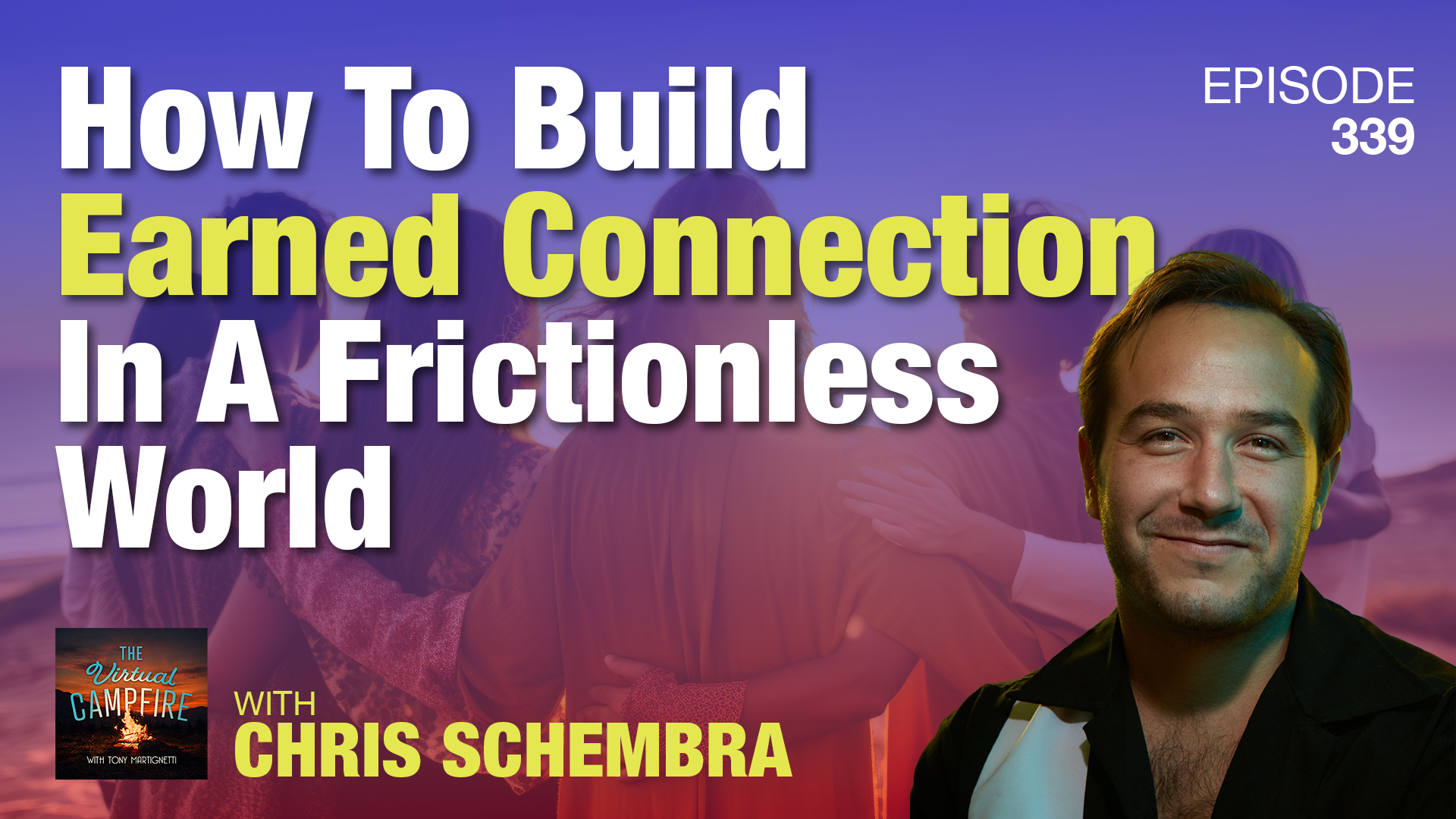
In this episode of The Virtual Campfire, Tony Martignetti welcomes Chris Schembra, founder of the 7:47 Gratitude Experience and bestselling author of Gratitude Through Hard Times and Gratitude and Pasta.
Together, they explore the transformative power of curiosity, intergenerational relationships, gratitude, and the kind of human connection that cannot be manufactured through shortcuts.
From a grandfather’s deeply personal letter to an extraordinary encounter with a legendary actor, Chris shares the experiences that shaped his understanding of what it means to live fully, love deeply, and leave something meaningful behind.
At the heart of the conversation is a powerful conviction:
Connection isn’t simply something we find. It’s something we earn through the willingness to show up for one another.
A Grandfather’s Letter and the Meaning of Legacy
Sometimes the most profound lessons arrive in the simplest forms.
During his conversation with Tony, Chris finds himself sitting in a room filled with deeply personal memories.
It’s the room where his grandfather, Donald Levinson, spent his final days while battling pancreatic cancer. On June 10, 2001, just 23 days before his passing, Donald wrote a letter to his grandson. The letter reflected on his life, the importance of family, and the values he hoped Chris would carry forward. One passage offered a particularly meaningful measure of a life well lived: treating others with respect, dignity, and caring.
For Chris, those three words represent much more than a sentimental family memory. They have become a guiding philosophy.
His grandfather served in the United States Navy during World War II, volunteered in his community, and demonstrated generosity through his actions. Looking back, Chris recognizes how those values continue to influence his own work. His commitment to bringing people together, creating meaningful experiences, and encouraging generosity reflects a legacy that extends far beyond his grandfather’s lifetime.
Tony connects this idea to the responsibility we all have to become examples for the people around us. Leadership isn’t always about being the brightest person in the room. Sometimes it’s about becoming a light that helps others find their way.
The lesson: The most meaningful legacy we leave may not be what we achieve, but how we make other people feel and the values we inspire them to carry forward.
The Boat Captain Who Learned to Connect Through Questions
Before becoming an author and creating experiences for organizations around the world, Chris began his professional journey in the South Carolina Lowcountry.
He worked as a kayak tour guide and eventually became a licensed commercial boat captain. His responsibility was to guide visitors through the waterways surrounding Hilton Head Island, sharing the region’s history, culture, and natural beauty. But Chris quickly discovered that the most memorable experiences weren’t created by simply delivering information. They came from helping people connect emotionally with what they were seeing.
He learned to use questions that connected the present moment with personal memories. A bird, a tree, or a body of water could become an invitation to remember a childhood experience, reconsider a familiar place, or see something ordinary through a new perspective. Sometimes nature became the central character in the story. Other times, the person experiencing it became the focus.
This approach helped Chris develop a skill that would eventually become central to his life’s work: creating environments where people feel present, curious, and genuinely connected.
The lesson: A thoughtful question can transform an ordinary experience into something deeply personal.
Eight Hours, One Rock, and an Unexpected Opportunity
One of the most memorable stories in Chris’s journey begins when he moves to New York City in 2011.
He arrives with limited resources, an uncertain professional direction, and the hope of building a new life. Interested in acting, he receives the business card of veteran actor Tony Lo Bianco. Chris reaches out and asks whether he can visit to learn about the acting business.
When he arrives at Tony’s Manhattan apartment, he’s carrying a yellow sheet of paper covered in questions. But the conversation doesn’t unfold as expected. Tony sets the questions aside, retrieves a rock from his windowsill, places it in front of Chris, and challenges him to ask the rock questions instead.
What begins as an unusual exercise in curiosity develops into an extraordinary eight-hour encounter. They explore what the rock might have experienced, where it might have been, and what stories it might hold. As the afternoon unfolds, they talk about life, share food, and discover an unexpected connection. By the end of the visit, Tony offers Chris an opportunity to return and help him with work around the apartment. That invitation becomes the beginning of a five-year working relationship.
Chris goes on to work alongside Tony in theatre production, travel with him, and learn lessons about business, negotiation, resilience, and human relationships. Looking back, Chris recognizes that Tony wasn’t simply assessing his qualifications. He was observing his willingness to engage, ask questions, embrace uncertainty, and trust an unfamiliar process.
Chris describes their relationship as something closer to eldership than traditional mentorship. It was an opportunity to learn through proximity, participation, and the experience of working alongside someone with a lifetime of hard-earned wisdom.
The lesson: Sometimes the greatest opportunities emerge when we stop trying to impress people and become genuinely curious about the world around us.
Why Wisdom Cannot Be Downloaded
Chris and Tony explore an important distinction between acquiring knowledge and developing wisdom.
Information has become extraordinarily accessible. We can learn about almost anything through books, videos, online courses, and artificial intelligence. But understanding something intellectually isn’t the same as experiencing it.
Chris argues that wisdom develops through participation. It requires patience, mistakes, uncomfortable situations, and the willingness to engage with life rather than simply observe it. A person can study negotiation without ever experiencing a difficult conversation. They can read about leadership without having to make a consequential decision. And they can consume endless advice about relationships without taking the risk of being genuinely vulnerable with another person.
Knowledge can help prepare us. Experience is what gives that knowledge depth.
For Chris, the five years spent working alongside Tony Lo Bianco illustrate this distinction perfectly. The lessons weren’t delivered through a conventional classroom. They emerged through shared experiences, challenges, conversations, and the responsibilities of real work.
The lesson: Information can tell us what to do. Experience helps us understand why it matters.
Earned Connection: Why the Hard Things Matter
Chris’s developing book, Earned Connection: The Dirty Work of Being Known, explores a concern that runs throughout the conversation.
As the world becomes increasingly optimized for convenience, are we losing our willingness to do the difficult things that make us human? Sending a quick message is easy. Having an honest conversation can be difficult. Consuming information is convenient. Applying it requires effort. Following familiar opinions can feel comfortable. Questioning our assumptions demands courage.
Chris describes the value of deliberately introducing friction into our lives. Not unnecessary obstacles, but meaningful challenges that require patience, presence, humility, and genuine participation. He draws a memorable comparison to cooking.
Some things simply cannot be microwaved. They need time to simmer. Human connection is one of them.
The Difference Between Convenience and Connection
Chris and Tony also examine the impact of technology and artificial intelligence on the way we think and relate to others.
Chris raises concerns about what can happen when digital experiences reinforce our existing beliefs without encouraging enough reflection or disagreement. He argues that we need to become more discerning about the information we consume and the assumptions we accept.
Rather than allowing convenience to dictate our decisions, he encourages us to create space to think independently, listen to challenging perspectives, and recognize that we don’t always have the answers.
The conversation isn’t about rejecting technology. It’s about remembering that greater efficiency doesn’t automatically create greater meaning.
The lesson: The easiest path isn’t always the one that helps us grow, and the fastest connection isn’t necessarily the deepest.
From Shared Frustration to Shared Joy
Another powerful idea emerges when Chris discusses the communities we choose to create.
People often come together because they share an objection, frustration, or common enemy. But Chris challenges us to consider another possibility. What if we built more communities around shared joy, generosity, meaningful activities, and a desire to contribute something positive? He describes the possibility of creating experiences that bring people together through what they love rather than what they oppose.
This philosophy is reflected in his invitation for people to gather around his dinner table in New York City. For Chris, the dinner table represents much more than a place to share a meal. It’s an opportunity to meet people, exchange stories, challenge assumptions, and form relationships that might otherwise never exist. The invitation is simple. Accepting it may require effort. And that willingness to show up is precisely where meaningful connection begins.
Key Takeaways From This Episode
- Legacy is lived, not simply remembered. Respect, dignity, and caring become meaningful when we demonstrate them through our actions.
- Questions create connection. Curiosity can help people feel seen, understood, and connected to the world around them.
- Unexpected encounters can change our direction. Chris’s meeting with Tony Lo Bianco demonstrates the power of openness and genuine engagement.
- Wisdom requires experience. Knowledge becomes more valuable when tested through real-world challenges.
- Meaningful relationships take effort. Presence, vulnerability, and patience cannot be replaced by convenience.
- Technology requires discernment. We need space to question assumptions and think independently.
- Communities can be built around shared joy. Connection becomes more powerful when people gather to contribute rather than simply oppose.
- A meaningful legacy begins with how we treat others. Small acts of care can have consequences far beyond our own lifetime.
Making It Work: Three Ways to Earn Deeper Connection
- Ask a Question That Goes Beyond the Surface
The next time you speak with someone, resist the temptation to move immediately into familiar conversation.
Ask about an experience that shaped them, a lesson they’ve carried forward, or something they’ve recently discovered.
Then give them the time and attention to answer.
- Choose One Meaningful Inconvenience
Reach out to someone you’ve been meaning to reconnect with.
Arrange an in-person conversation instead of another exchange of messages.
Make time for an experience that requires your full attention.
The effort itself may be part of what makes the experience valuable.
- Consider the Legacy You’re Creating Today
Think about the three words Chris’s grandfather left behind:
Respect. Dignity. Caring.
How might those values influence the way you lead, collaborate, or support someone this week?
You don’t have to wait until the end of your life to create a meaningful legacy.
You create it through the way you show up today.
A Question to Take With You
Are you making your life more convenient, or are you making it more meaningful?
There’s nothing wrong with efficiency. But some of life’s most important experiences require us to slow down, pay attention, and do the difficult work of genuine connection.
Perhaps the next meaningful opportunity isn’t waiting behind another productivity tool, another book, or another piece of advice. It’s waiting in a conversation you’ve been putting off. A question you haven’t asked. Or a dinner invitation you haven’t accepted.
Because sometimes the smallest moments of genuine connection leave the greatest legacy.
About Chris Schembra
Chris Schembra is the founder of the 7:47 Gratitude Experience, a methodology used with organizations including Google, Microsoft, Dell, IBM, Johnson & Johnson, and the United States Navy.
He is the author of Gratitude Through Hard Times and Gratitude and Pasta. His developing book, Earned Connection: The Dirty Work of Being Known, explores the effort, humility, and presence required to create meaningful relationships.
His work focuses on gratitude, connection, storytelling, and designing experiences that help people feel genuinely known.
IMPORTANT LINKS FROM THE SHOW

HAL Gregersen’s Links