


“We are not built in a day. We are built, and rebuilt, out of what we already are.”
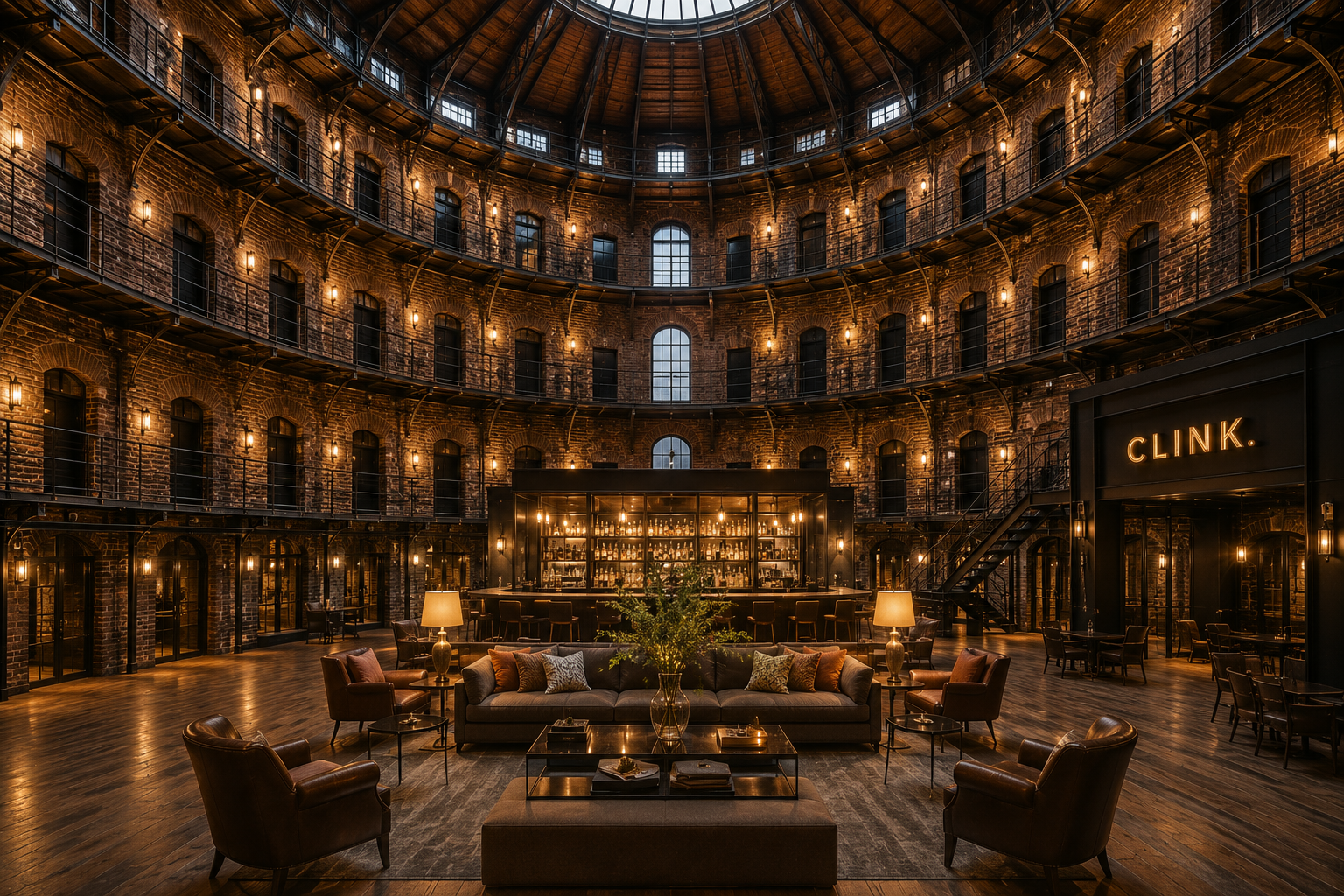
There is a hotel in Boston where you can eat dinner in a former drunk tank. With a bar called Alibi and a restaurant called Clink, the connection to the past is clearly part of the branding. The lobby is a soaring octagonal rotunda that was once the central hub of a jail, designed in 1851 so that guards could see down every corridor at once. For more than a century, the Charles Street Jail held prisoners under that rotunda. Then it held nothing at all, closed in 1990 after a federal court ruled its conditions inhumane.
And then, instead of tearing the building down, someone decided to keep the bones. The granite facade stayed. The catwalks stayed. The rotunda stayed. A new sixteen-story hotel tower was built around the historic shell, and in 2007, the Liberty Hotel opened. Guests now sleep inside a building that once confined people. The irony is not accidental. It is, in fact, the point.
Three thousand miles east, in Paris, a similar story played out across a different century. The Gare d’Orsay was built in 1900 for the Universal Exposition, designed by Victor Laloux as a grand Beaux-Arts railway terminal serving southwestern France. By 1939, its platforms were too short for modern electric trains, and the station was retired from mainline service. For the next several decades, the building lived a series of intermediate lives: a parcel dispatch center during the war, a reception point for returning prisoners and deportees at the Liberation, an auction house, a theater, and (in one of its more cinematic chapters) the set where Orson Welles filmed The Trial in 1962.
In 1977, President Valéry Giscard d’Estaing made a decision that would have struck an earlier generation as absurd: he designated a defunct train station as the future home of France’s national collection of Impressionist and Post-Impressionist art. Italian architect Gae Aulenti designed the interior galleries. The soaring iron-and-glass barrel vault remained. The great ornamental clock remained. And on December 1, 1986, the Musée d’Orsay opened. A building designed to move people through space became a place that holds them still in contemplation. Same bones. New purpose. The past is not demolished, but integrated.
Why Tearing It Down Is Almost Never the Right Move
I keep thinking about these buildings because they answer a question I hear constantly from the leaders I work with: what do I do with the parts of me that no longer fit?
The version of you that built the first company. The skill set that got you promoted into a role you have since outgrown. The creative self you sidelined to be taken seriously. These are not failures. They are not liabilities. They are not things to demolish. They are the structural foundation of whatever comes next, if you are willing to keep the bones.
The architect Stewart Brand had a useful insight about this: every building is really six layers, each changing at a different speed. Site, Structure, Skin, Services, Space Plan, and Stuff. The site is essentially permanent. The structure lasts for decades or centuries. The stuff (furniture, objects, the daily artifacts of use) changes constantly. A well-designed building lets the fast layers change without destroying the slow ones. A poorly designed one forces you to tear everything down just to rearrange the furniture.
Leadership identity works the same way. Your values, your hard-won character, the lessons that formed through difficulty and reinvention; those are your site and structure. They should be permanent. Your role, your title, your current strategy, the way you show up in a particular organization at a particular time; those are your space plan and stuff. They are supposed to change. The leaders who get stuck are the ones who confuse the layers: either they try to change their foundation every time the environment shifts, or they refuse to change their surface because they have mistaken it for their identity.
The Mechanics of Having More Than One Life
The psychologist Dan McAdams has spent decades studying what he calls narrative identity: the internalized, evolving life story each of us constructs to make sense of who we are. His research shows that the healthiest, most resilient people are not the ones who have had the smoothest lives. They are the ones who have learned to integrate their past chapters into a coherent story, including the chapters that were painful, confusing, or that seemed, at the time, like dead ends.
McAdams calls this a redemptive narrative: a story in which earlier difficulty becomes the foundation for later meaning. The Charles Street Jail did not become the Liberty Hotel despite its history. It became the Liberty Hotel because of it. Confinement is what makes freedom resonate. The past is what gives the present its texture.
This is what I mean when I talk about illuminating hidden brilliance. The dimensions of yourself that you have been carrying (the ones that do not fit neatly into your current role, the ones that feel like relics of a previous life) are not dead weight. They are dressed stone, waiting to be set into the next arch. The question is not whether they belong. The question is whether you are willing to build with them.
Do Try This At Home: An Adaptive Reuse Inventory
Take ten minutes this week and try this. Write down three roles, skills, or identities from a previous chapter of your life that you have largely set aside. Not because they failed, but because you moved on. The musician who became a strategist. The caretaker who became a CEO.
Now ask yourself: which of these is structural, something that shaped how you think, how you lead, how you see the world, and which is surface-level? The structural ones are your rotunda. They are not meant to be demolished. They are meant to be the lobby of whatever you build next.
The Liberty Hotel kept its catwalks. The Musée d’Orsay kept its clock. Neither pretended to be a brand-new building on an empty lot, and that is precisely why they are worth visiting. So are you.
If this resonated with you and you’re thinking about what it might look like to bring more of this into your work, I’d invite you to stay connected.
Join my newsletter
Or book time to connect.