


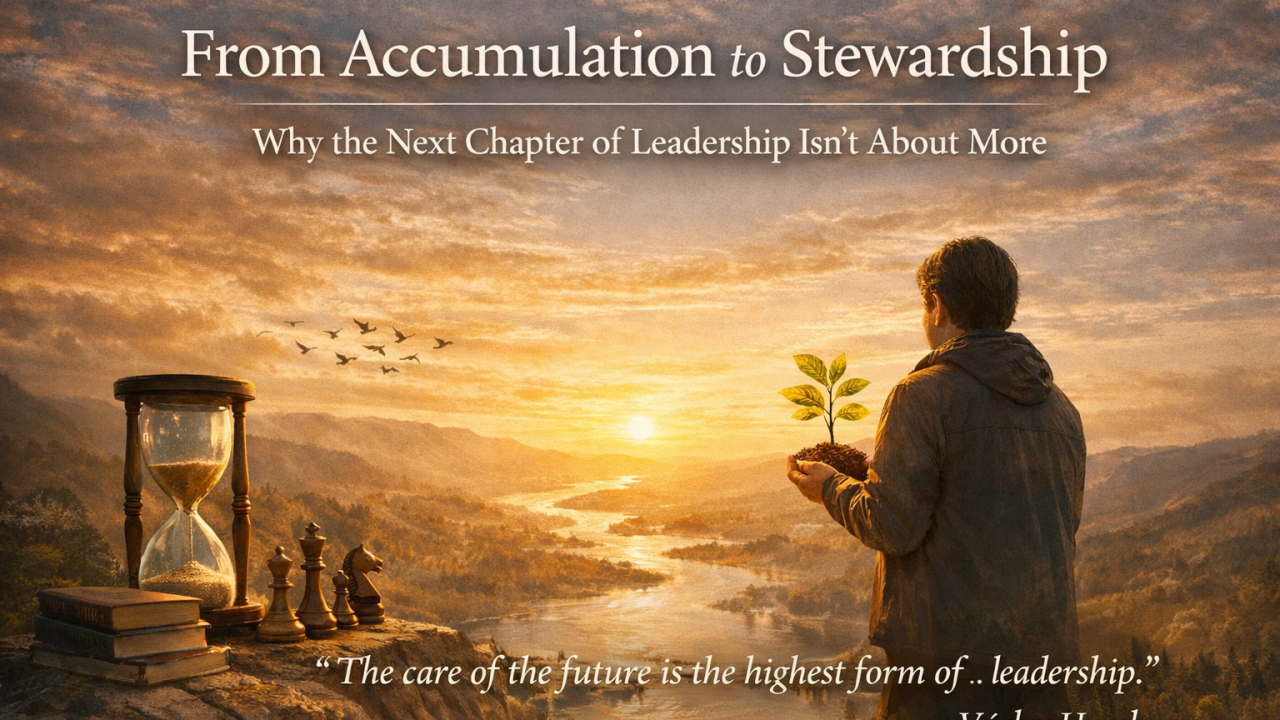
“The care of the future is the highest form of leadership.” — Vaclav Havel
For a long time, leadership has been measured by accumulation: more responsibility, more visibility, more influence, more ideas in motion, more seats at the table, and more metrics that signal progress. Accumulation has been treated as evidence of momentum, and momentum as proof of success.
But lately, I have been questioning that equation. As I step into a new chapter of work and life, I can feel the limits of accumulation more clearly than ever. Not because ambition has faded, but because the cost of carrying too much without discernment has become impossible to ignore. There comes a point when growth no longer asks for expansion, but for care, not for more input, but for wiser governance. This is where stewardship enters the conversation.
Stewardship is rarely celebrated in leadership culture because it doesn’t announce itself loudly. Yet stewardship is what allows meaningful work to endure. It is the discipline of holding what matters—ideas, people, resources, energy—with intention rather than impulse. The shift from accumulation to stewardship is subtle, but profound. It marks the difference between building something impressive and sustaining something meaningful.
When “More” Stops Being Neutral
Early in our careers, accumulation is often necessary. We gather experience, skills, exposure, and relationships. We test ourselves against complexity and stretch into unfamiliar territory. Accumulation, at that stage, is how we learn who we are and what we’re capable of. The problem is that many leaders never update the strategy.
What once served learning slowly becomes default behavior. We keep saying yes because saying yes used to be the right move. We keep adding because subtraction feels risky. Over time, accumulation stops being a tool and becomes an identity. And that’s when misalignment quietly sets in. The warning signs are rarely dramatic. They show up as persistent fatigue that doesn’t go away with rest. As decision-making that feels heavier than it should. There is a subtle disconnection between what we’re doing and why it matters. Nothing is “wrong,” exactly, but something feels off. Stewardship begins with noticing that feeling and taking it seriously.
Stewardship Is a Design Choice
One misconception about stewardship is that it’s passive or even conservative. In reality, stewardship is an active design practice. It requires clarity about what deserves protection, what needs cultivation, and what no longer belongs in the system. This applies to organizations, but it applies just as powerfully to individual leaders.
A steward doesn’t ask, what can I add? They ask, what am I responsible for holding well?
That shift changes everything. It reframes leadership as an act of curation rather than accumulation. Attention becomes a scarce resource, and energy becomes something to steward rather than spend freely. Influence becomes something to wield with care, not to maximize at all costs. In this framing, restraint is a form of wisdom.
From Ownership to Guardianship
Another subtle transition that accompanies stewardship is the move from ownership to guardianship. Ownership implies control, while guardianship implies responsibility across time. When leaders operate from a sense of ownership, decisions are optimized for immediate outcomes: speed, efficiency, recognition. When they operate from guardianship, decisions are filtered through a longer lens. They consider second-order effects. They ask what today’s choice makes easier or harder for those who come after.
This perspective is especially important for leaders whose work spans multiple domains. Multidimensional leaders often sit at intersections where short-term gains can quietly undermine long-term integrity. Stewardship helps reconcile those tensions by anchoring decisions in values rather than velocity.
The Inner Work of Stewardship
Stewardship isn’t only external. It requires a different relationship with the self. Accumulation thrives on self-containment: I can handle this. I’ll push through. I’ll figure it out. Stewardship, by contrast, recognizes limits, not as weaknesses, but as signals. It invites reflection. It legitimizes asking for perspective. It values pause as much as progress.
This is one reason why structures such as a personal Board of Directors become increasingly critical in stewardship-oriented leadership. Not because leaders lack capability, but because discernment improves when responsibility is shared. Stewardship thrives in relationships because it resists isolation.
The most meaningful accountability I have experienced hasn’t come from metrics or deadlines, but from conversations with people who see the whole arc of my work and aren’t invested in my busyness. They help me notice drift before it becomes damaging. They ask questions that slow me down in generative ways.
Letting Go as a Leadership Skill
One of the most challenging aspects of stewardship is learning what to release. Letting go isn’t failure, but it often feels like one. Especially for leaders whose identities have been shaped by their contributions and capabilities. Yet stewardship demands periodic pruning. Not everything that once mattered still does. Not every opportunity that aligns is meant to be taken. This kind of letting go is not reactive; it is intentional, creating space for depth to replace breadth and for coherence to replace complexity. It allows leaders to move from managing many things adequately to tending a few things well. There is quiet confidence in this shift, as it assumes that what remains will carry more meaning than what was added.
Designing for Endurance
If accumulation is about growth, stewardship is about endurance. Endurance means designing systems, both personally and organizationally, that can adapt without fracturing. It means investing in relationships that can hold tension. It means building rhythms that support renewal rather than depletion. In a world that increasingly rewards immediacy, stewardship is a countercultural stance. It insists that not everything valuable can be accelerated. Some things require time, care, and patience to reveal their worth. As leaders, the question eventually shifts. Not what can I take on? but what must I tend to if this work is to remain alive?
I don’t believe the next era of leadership will be defined by those who accumulate the most influence, ideas, or attention. I believe it will be shaped by those who learn to hold complexity without being consumed by it. Those who design with care. Those who govern their energy, relationships, and commitments with intention. The move from accumulation to stewardship is not a retreat; it’s an arrival. It’s the moment when leadership stops being about proving capacity and starts being about honoring responsibility. When success is no longer measured by expansion alone, but by alignment, sustainability, and meaning over time.
As you step into whatever comes next, the question worth sitting with may be: what am I now called to steward well? And if you’re willing to stay with this question for a bit, it may change everything for you.
If this resonated with you and you’re thinking about what it might look like to bring more of this into your work, I’d invite you to stay connected.
Join my newsletter
Or book time to connect.