
What if creativity isn’t something reserved for artists, designers, or people who consider themselves naturally creative?
What if it’s something all of us already possess, but need to learn how to access?
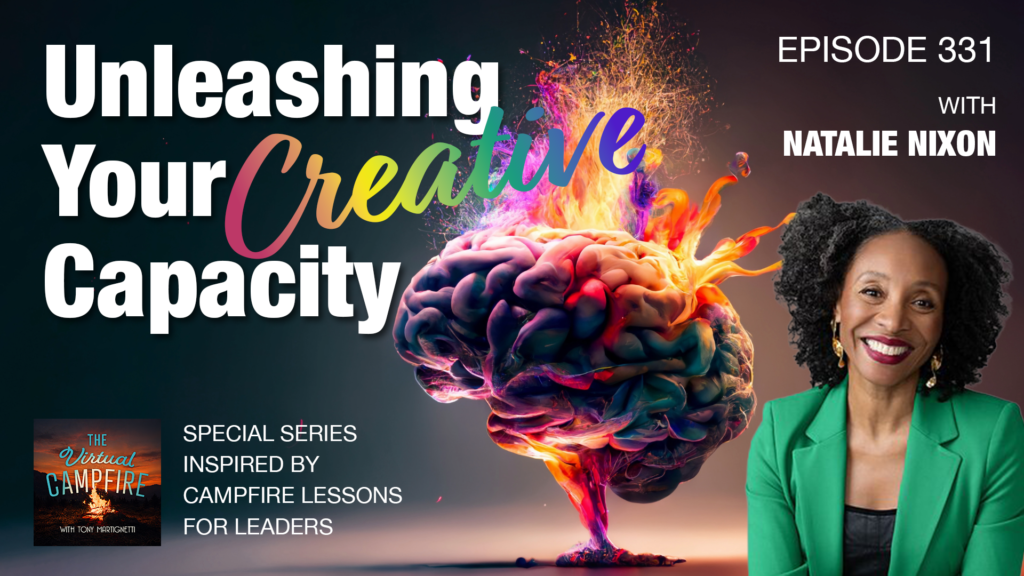
In this episode of The Virtual Campfire, Tony Martignetti sits down with creativity strategist, author, and self-described “ideas artist” Natalie Nixon for a wide-ranging conversation about curiosity, creativity, movement, imagination, and what it means to do our best thinking.
Natalie’s own path has rarely followed a straight line. From anthropology and international experiences to dance, academia, design, innovation, and entrepreneurship, she has built a career by bringing seemingly different experiences together and allowing each one to inform the next.
Along the way, she has discovered something important: creativity isn’t simply about having great ideas. It’s about creating the conditions that allow those ideas to emerge.
Creativity Belongs to Everyone
For years, Natalie encountered people inside organizations who didn’t consider themselves creative.
Creativity belonged to marketing. Advertising. Designers. The “creative people.” But Natalie saw something different.
She watched attorneys, engineers, scientists, leaders, and other professionals solve problems in deeply creative ways. Often without recognizing what they were doing as creativity.
That observation helped shape her work: making creativity accessible and helping people understand that it is a capacity that can be cultivated.
Creativity isn’t an identity reserved for a select few. It’s a way of thinking, exploring, questioning, and making connections.
Wonder Needs Rigor
Natalie describes creativity as the ability to toggle between wonder and rigor.
Wonder allows us to ask questions, explore possibilities, stay curious, and imagine what might be.
Rigor gives those possibilities structure.
Natalie’s own journey reflects that balance. Her academic work grounded her in research, theory, and fundamentals. Her experiences in consulting, teaching, travel, dance, and entrepreneurship continually challenged her to explore beyond those boundaries.
The lesson is simple but powerful:
We need both.
Wonder without action can remain an idea.
Rigor without wonder can keep us repeating what we already know.
Creativity happens when the two work together.
Move. Think. Rest.
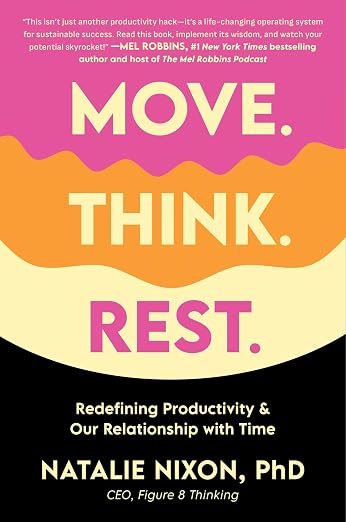
Natalie’s latest work challenges another assumption: that productivity means continually doing more.
Her framework of Move, Think, Rest offers a more human-centered approach.
Movement isn’t simply exercise. Our bodies were designed to move, and physical movement plays a role in how we think.
Thinking isn’t limited to quick analysis and problem-solving. Reflection, memory, curiosity, imagination, and even daydreaming contribute to better thinking.
And rest isn’t simply sleep. Micro-breaks, buffers, stepping away, and creating space can all allow ideas to develop in ways that constant activity cannot.
Sometimes the breakthrough arrives precisely because we stopped trying to force it.
The Human Revolution
As technology becomes increasingly capable, Natalie believes an important opportunity is emerging.
Rather than simply asking how much more technology can allow us to produce, perhaps we should ask what that efficiency gives us the opportunity to reclaim.
More space.
More conversation.
More experimentation.
More reflection.
More imagination.
Natalie argues that we may think we’re experiencing a technological revolution, when in many ways we’re actually experiencing a human revolution.
Our ability to sense, interpret, imagine, intuit, connect, and understand one another becomes increasingly valuable when technology can provide information almost instantly.
The future doesn’t require us to become more like machines. It may require us to become even better at being human.
Creativity Starts With How You Live
For Natalie, creativity doesn’t begin when she sits down at her desk. Dance informs her work. Swimming helps her move from her head into her body. Living in different countries expanded her ability to observe people and cultures. Anthropology taught her to notice. Academia gave her rigor. And curiosity keeps all of those experiences connected.
Our lives outside of work aren’t necessarily distractions from our work. They may be where some of our most valuable ideas begin.
Becoming More Human in the Work
One of Natalie’s more personal realizations has been that expertise alone isn’t enough. For years, she wanted people to take her work, and creativity itself, seriously. So she often led with research, frameworks, theory, and data. Over time, she discovered that allowing people to see more of the person behind the ideas made those ideas more powerful, not less. Being personable made her more relatable. And being more relatable created a stronger bridge for everything else she had to offer.
It’s another reminder that our greatest contribution may not come from separating the personal from the professional. It may come from allowing more of ourselves into the work.
Unleashing Your Creative Capacity
Creativity isn’t a switch that some people possess and others don’t. It’s a capacity. And like any capacity, it can be strengthened. Through curiosity and discipline. Movement and stillness. Knowledge and experimentation. Wonder and rigor.
Natalie’s story reminds us that the goal isn’t necessarily to become a different person to become more creative. It may be to give ourselves permission to use more of the person who is already there.
In This Episode, You’ll Explore
- Why creativity isn’t limited to traditionally “creative” professions
- How wonder and rigor work together
- What dance, travel, and anthropology taught Natalie about creativity
- Why fundamentals can actually create greater freedom
- How small shifts can create meaningful change
- Natalie’s Move, Think, Rest approach to productivity
- Why stepping away from work can improve our thinking
- How movement can fuel imagination and creative work
- Why Natalie believes we’re entering a human revolution
- What distinctly human capabilities matter in an AI-driven world
- Why becoming more personal can make our ideas more powerful
- How to begin cultivating your own creative capacity
A Question to Take With You
What part of your creative capacity might be waiting for you to give it more room?
Sometimes creativity doesn’t require finding something outside of ourselves. Sometimes, it begins by making more space for what’s already there.
important episode Links
Natalie Dixons Links
Natalie’s Company Website
figure8thinking.com
Natalie’s LinkedIn
linkedin.com/in/nataliedixonphd
Natalie’s Instagram
instagram.com/natwnixon
Natalie’s Latest Book
Move. Think. Rest.